The Next Generation of HDRM motors

Next generation UK-manufactured motor reaps efficiency gains for heavy duty applications

Advanced Electric Machines (AEM) sets new standards in electric motor efficiency with next-generation solution

  • New HDRM300C motor brings stronger performance and greater efficiency to AEM’s commercial vehicle-focused motor
  • Revolutionary compressed coil technology achieves over 80% conductor slot fill rate compared to conventional 60%
  • Enhanced thermal management and cooling design delivers superior continuous performance; higher top speed adds greater flexibility for customers
  • Samples available from March, production due to commence in Q4 2025

Advanced Electric Machines (AEM), the UK-based manufacturer of sustainable, magnet-free electric motors, has unveiled the second generation of its popular solution for heavy duty and commercial vehicle applications. HDRM300C strengthens AEM’s position as a leading producer of rare-earth free motors and provides customers with an enhanced motor that offers stronger performance and greater efficiency.

Building on the success of its HDRM150 motor, where AEM first developed and validated its innovative coil compression technology, the HDRM300C represents a major advancement in electric motor design, achieving industry-leading conductor slot fill rates exceeding 80%. This proven technology, now evolved and scaled up from the smaller HDRM150, delivers measurably better power density and efficiency compared to conventional wire layouts that typically achieve less than 60% fill rates.

“The HDRM300C represents more than just an incremental improvement in motor technology,” says James Widmer, CEO of Advanced Electric Machines. “By combining our patented coil compression technology with enhanced thermal management and improved speed capabilities, we’re delivering a motor that sets new benchmarks for efficiency and performance. For the transportation industry, this means more capable electric vehicles that are more cost effective to operate and maintain.”

The practical benefits extend beyond pure performance. The HDRM300’s increased speed capability provides greater flexibility for system integration across diverse applications. New plug-in connectors have replaced traditional gland fittings, simplifying the installation and maintenance process, while maximising overall reliability. Internal components, including upgraded bearings and robust busbar connections, have been strengthened to support the motor’s higher operational speeds.

An improved motor cooling system, which works similarly to a car’s radiator, allows the machine to work harder for longer without overheating. This is particularly important for commercial vehicles, where consistent performance throughout the day is crucial. For fleet operators and vehicle manufacturers, this translates to vehicles that can carry heavier loads, climb steeper hills, and operate in more demanding conditions without compromise.

Sample units will be trialled with select partners from March 2025, with full production scheduled to commence in Q4 2025. The launch represents a significant milestone in AEM’s mission to revolutionise electric motor technology and establish new standards for sustainable transportation.

*Please note the omittance of ‘S’ in the product name (formally HDSRM). This is a product line rebrand and also applies to AEM’s HDRM150 motor.

About AEM

Advanced Electric Machines’ vision is to design and build the world’s most sustainable EV motors for the global automotive and transport sectors. It utilises its expertise in materials, manufacturing and design to ensure its solutions are not only more sustainable, but also more efficient and cost-effective.

Based in the Northeast of England, Advanced Electric Machines Limited was founded in 2017, when it was spun out from Newcastle University’s world-class electric motor research team, led by AEM’s CEO, Dr James Widmer, and CTO, Dr Andy Steven.

AEM technologies are covered by 46 international patents protecting their unique motor designs and manufacturing processes around the world.

Contacts:

Advanced Electric Machines

John Edden, Torque Agency Group

jedden@torqueagencygroup.com | +44 (0) 7403 640 213

Euan Antona, Torque Agency Group

eantona@torqueagencygroup.com | +44 (0) 7702 334 887
A rare-earth free, efficient future for our railways

Electric motors are everywhere. Pretty much everything manufactured or engineered in the last 60 years will have benefitted from their involvement. They build our homes, our workplaces, the roads on which we drive, and the smartphones in our pockets – without electric motors, the world would be a very different place.   

Our high societal dependency on electric motors is, naturally, good news for us at AEM. It means that we have the scope to deploy our semi-sinusoidal technology in a multitude of different sectors and applications. So far, our focus has been on supporting the automotive sector. But, behind the scenes, our technology is also being used to help repair and maintain the UK’s railways.

An electrified railway

The rail industry, both light and heavy, is a major consumer of electric motors. Though many of our routes are electrified in the UK, other countries around the world operate electric infrastructure almost exclusively.

Electrified track needs electric locomotives, multiple units and trams, each utilising traction motors. Even in combustion-engined trains, it’s become common for manufacturers to adopt a high-efficiency ‘diesel-electric’ model. This sees the train or locomotive’s engines used to generate electricity, rather than drive the wheels. The electricity is then fed to traction motors to provide the motion.

Then, you’ve got a broad array of infrastructure maintenance equipment, such as tamping units, road-rail vehicles and catenary installation machines. All are likely to either make use of electric powertrains in the near future if they aren’t already. 

Same motors, same issues

When it comes to pre-existing motor technology, the rail industry suffers from the same issues as the automotive sector. Where permanent magnet technology is deployed, predominantly on maintenance machinery, the motors rely on rare-earth permanent magnets. These use finite metals in limited supply and are environmentally damaging to extract and process.

Induction motors are more commonplace on locomotives and multiple units, but these have their weaknesses, too. While they don’t use magnets like a permanent magnet machine, they are notably less efficient. The result is that more fuel is needed to achieve the required tractive effort.   

AEM’s electric motor technology is both rare-earth free and even more efficient than a permanent magnet machine. Our design swaps a permanent magnet or induction design for an electrical steel rotor. Not only does this make it more sustainable to manufacture and easier to recycle, but it has proven to be more power dense and safer to run.

Making inroads

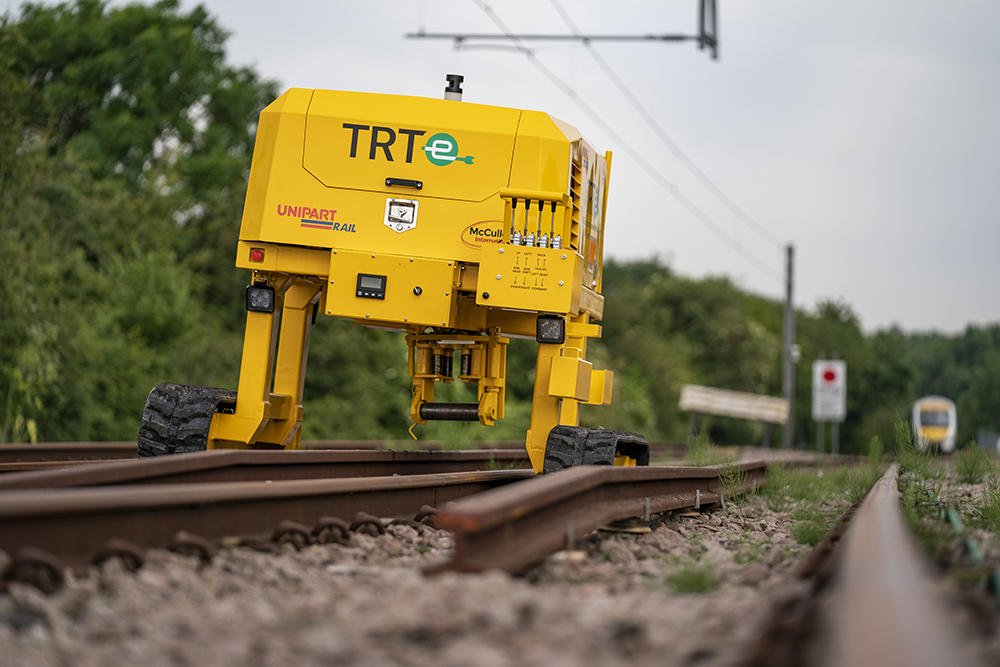
As we mentioned earlier, we have already taken steps to increase our presence in the rail sector over the last couple of years. Through our partnership with McCulloch Group and Unipart Rail, we have provided the electric motors for the industry-changing TRT-e – a zero-emissions Trac Rail Transposer. The vehicle is used to move sections of the railhead during track engineering works.

TRT-e has been in regular use with Network Rail, demonstrating considerable noise and emissions benefits when used over a similar diesel-powered equivalent.

Sector transformation doesn’t happen overnight. We’re excited about the opportunity that the railways possess, and our relationship with McCulloch Group, we feel, is a rewarding and positive start.  

What is the true scale of electrification? 

By now, it would have been nigh on impossible to have avoided discussion about automotive electrification. High on the list of priorities of governments, industry, and various climate scientists across the globe, the electric vehicle dialogue has intensified over the years. 

Much of this dialogue centres around passenger cars, trucks and vans.  

With the prominent role that these vehicles play in the everyday lives of most people, this seems reasonable. And yet, there are so many other types of vehicle that get overlooked when we talk about electrification. These vehicles, much like passenger cars, are integral to society, as well as the economy. 

One such example is the bus. Renowned for getting a wide cross-section of the general public from A to B, these vehicles make up an important part of the electrification landscape. According to a statistical release published in October 2020 by the United Kingdom’s Department for Transport, local bus services travelled a total of 1.13 billion miles in the year ending March 2020. If left unelectrified, the carbon footprint of these vehicles will remain substantial. In 2020, despite the pandemic significantly reducing travel, the emissions from UK buses was still 2.2 million metric tonnes, which is enough to fill 440,000 hot air balloons. 

In many places across the world, including in the UK, this is a problem that is being tackled. In Indonesia, for example, PT INKA, a state-owned rolling stock and automotive manufacturer, has collaborated with Advanced Electric Machines to manufacture  electrified buses. These buses will contain our sustainable electric motor technology and will be crucial to meeting the Indonesian government’s commitment to electrifying its fleet of public transportation buses by 2030.

Also overlooked are off-highway vehicles. Used on steep or uneven ground, off-highway vehicles are used in the construction and agricultural sectors, including everything from mining vehicles and tractors to mobile platforms and cranes. Consider the fuel required for one bulldozer to function on a construction site for one day’s work. Powering this vehicle with an internal combustion engine goes against the sustainable practices that the imminent bans of petrol and diesel passenger cars the world is striving towards. 

In our work with SCG International, we have been working alongside the cement and building material provider to make a difference in Thailand’s construction industry. Advanced Electric Machines and SCG recently signed a memorandum of understanding to develop innovative solutions for SCG’s next generation of zero-emissions mixing and transportation machinery. In this capacity, we will integrate our unique electric motors into SCG’s forward-thinking product range. 

Our ambition to achieve greater sustainability in the transport sector has not stopped there, either. We have identified road trains as another vehicle type that has been neglected in the approach towards electrification. Particularly prominent in Australia, these vehicles undertake extremely long journeys to transport goods overland to remote areas.  

Qube Logistics is an Australian provider of import and export logistics services, operating long-distance road trains. In partnership with Adgero, Advanced Electric Machines’ sustainable technology is helping the company to boost the capacity and efficiency of its trains and minimise its running costs. Qube’s new sustainable e-axle solution will utilise our HDSRM300T drive system, with each axle fitted with two rare-earth free motors and a transmission. 

As you can see, there’s more to automotive electrification than merely passenger cars, trucks and vans. Research undertaken by the International Energy Agency has predicted that there will be 145 million of these types of vehicles electrified and on the road by 2030. But this 145 million doesn’t even remotely take vehicles used for construction, in agriculture, for public transport, and for various other means into account. It is clear that the scale of electrification is more than meets the eye, and it remains our goal here at Advanced Electric Machines to make sure that this process occurs in a sustainable manner. 

Our bespoke motoring solutions

Five years ago, we set out on our journey to build the world’s most sustainable electric motors. Along the way, we have always sought to develop long-term partnerships with like-minded companies that have wanted our technology to create a bespoke motor offering that fits their requirements. On this path, we have come across businesses in sectors from commercial vehicle to rail to renewables that have been drawn to us because of their desire for a high performing and truly sustainable product.

At AEM, we have a wide-ranging product portfolio that caters to the needs of those in search of an electric motor. Our HDSRM™ product family in particular offers a scalable and modular design to meet a variety of applications, including passenger cars and commercial vehicles, as well as in the maritime and railway industries.

Nevertheless, from time to time, we receive enquiries that specify a change in direction. Typically, the process of partnering with a business to provide them with the right product begins with our team investigating whether any of our products are tailored to their product specification. If there isn’t a match, we will look into how we can develop a product for them. This involves us identifying whether modifications can be made to one of our current motors to fit what is required, or whether we will need to build something entirely new.

In terms of making modifications, we take everything into account, from the length and weight of the motor to the amount of torque the customer requires. Within our product portfolio, there is plenty of room to manoeuvre, enabling us to cater to the needs of our customers to create the right product for them.

If this is not an option, and we see a bigger opportunity at play, we will go the extra mile and develop a bespoke motor with our customers. This process is a collaborative approach; although the designing and manufacturing are done by us, we remain in constant communication with our customers to ensure we are creating a product that fits all their requirements. In our partnership with the commercial vehicle manufacturer, SAF-Holland, for example, we have been holding weekly progress meetings and maintaining an ongoing action list for over a year now. Over this period, we have designed and manufactured a bespoke motor that integrates into SAF Holland’s innovative e-axle system, the TRAKr.

For these bespoke projects, we typically anticipate that the motor will be ready in 12 months, but we will always adapt to the situation at hand. As the manufacturer of the world’s most sustainable and high-performance electric motors, we welcome interest from other companies in establishing long-term relationships that can facilitate the development of the sectors we operate in. Whether our active product range is suitable for a prospective client’s needs or not, we are always open to collaborating and finding the right solution.

Our motor technology explained

As has been established, electric vehicles (EVs) are not without their drawbacks. Recycling issues and the modernisation of rare earth mining practices are big obstacles that need to be overcome in order to ensure a sustainable transition to implementing electrified transport. To compound this, any alternative solutions put forward are challenged with the need to be at least as powerful, torque dense and efficient as existing technologies.

The electric motor is a critical element of the EV powertrain, and must not be overlooked in the search for greater sustainability. For years now, the conventional permanent magnet machine has been the motor of choice for automotive manufacturers, and has been regarded as the most effective solution for electric vehicles. We have already established the environmental issues that this technology brings to the fore, and this has not been lost on vehicle manufacturers, who are now actively seeking rare-earth free alternatives.

The problem with this type of motor is not just environmental, but its relative cost and complexity. However, as some manufacturers move to rare-earth free options, they are finding themselves compromising efficiency and performance, and in some cases, their solutions are even less sustainable due to their increase in size and the increased amounts of alternative materials they use.

Step forward AEM. Our solution takes away these concerns, removing rare earth magnets from the motor design and simultaneously improving efficiency, increasing performance and lowering cost.

How? Well, we’ve replaced the rotor magnet with electrical steel, and the copper coils in the stator with highly compressed aluminium windings. As we’ve established, this has a hugely positive environmental impact, as our choice of materials means our motor is fully recyclable at end-of-life, leading to less e-waste.

The benefits of removing magnets from the motor also mean that operating risks are reduced, with no chance of short circuit currents or the high voltage spikes which can be experienced with permanent magnet motors. We can therefore ensure safer failure modes should something go wrong. In addition, our magnet-free motors have no risk of demagnetisation, as temperatures increase at higher rotational speeds, which allows for our motors to run much faster, whilst also enabling a simpler thermal management system for the vehicle.

In terms of cost, it is expensive to use rare earth magnets in motors, with each motor containing at least $200 worth of magnets alone. The volatile supply of neodymium – the main rare earth metal used in electric motors – also means there is significant scope for the price to increase much further. From February 2020 to February 2022, the cost of neodymium has risen by 312%, with one kilogram now costing more than $236, compared to $42 just two years ago. Put simply, vehicle manufacturers will find it difficult to plan the scale-up of electric vehicles in the numbers required when the cost of a key component can be so volatile.

And then there’s package efficiency. The faster a motor spins, the more power dense it can be. Typically, this faster spin will lead to problems with rare earths, but our motor is, of course, a little bit different. Without magnets, we can make the motor spin twice as fast, making it easier to package and lighter in weight. The fact that our motors are inert when not being driven enables the vehicle to coast. This has led to an increase in efficiency of up to 12% being reported by our customers over conventional permanent magnet motors throughout a typical vehicle drive cycle.

As you can see, our solution solves many of the problems that are found in producing electric motors. In order for electric vehicles to be as sustainable as possible, change needs to embraced, and if it is, then a truly green future can be a reality right now.

Find out more about our products.

AEM Leads Project To Establish UK Supply Chain For EV Drivetrains

  • AEM to lead Coil to Core: Supply Chain for Net Zero CO2 (COCO2) project
  • The COCO2 project will aim to establish a PEMD supply chain in the UK
  • The company’s involvement in the initiative demonstrates its commitment to achieving key industrial and environmental goals

Advanced Electric Machines (AEM) will lead the Coil to Core: Supply Chain for Net Zero CO2 (COCO2) project. The project, which will run from January 2022 to January 2025, will seek to develop a Power Electronics, Machines and Drives (PEMD) supply chain in the UK.

The newly established supply chain will develop cost-effective material supply and manufacturing of new high strength steels using innovative mass production processes. This will deliver patented lamination designs that can be stacked into novel rotor and stator sub-assemblies, allowing the mass production of more efficient and sustainable electric machines. These machines can be used across a wide range of applications in the transport, energy, and industrial sectors.

Throughout the project, AEM will be working alongside partnering organisations such as Tata Steel, the Centre for Process Innovation (CPI), and Coventry University. The project is funded by the Driving the Electric Revolution challenge at UK Research and Innovation.The project team’s goal is to establish a supply chain with a clear end-to-end route to market for electric vehicle drivetrains. To ensure the supply chain is both attractive to the market and profitable, the team will also undertake production costing and value chain analysis.

The COCO2 project is a clear demonstration of AEM’s commitment to achieving key industrial and environmental goals within the UK. Among these is a pledge to support innovation by developing a versatile range of materials, processes, and sub-assemblies. This innovation will produce the basis of more efficient and more sustainable electric machines that exclude the use of rare earth materials and copper.

In accordance with the UK’s drive towards net zero, sustainable routes to electric motor production will be established throughout the project. This, coupled with the development of sustainable electrification solutions, ensures that the initiative falls in line with the Government’s target of achieving a green industrial revolution in the transport, energy and industrial sectors.

James Widmer, CEO of AEM, said: “The growth in the electric vehicle market in recent years has shone a light on the need to bolster the electric vehicle driveline supply chain. The Coil to Core: Supply Chain for Net Zero CO2 project will see AEM and our partners establish a clear path for the mass production of efficient and sustainable electric machines. As a result, the transport, energy and industrial sectors will have an array of more environmentally viable options at their disposal.”

Tackling the sustainability of power electronics

It wouldn’t be overstating it to say that without power electronics the modern world would grind to a halt.

Power electronics has a role in just about every electrical engineering function that you can imagine. It’s in your mobile phone, it’s in your electric car (if you have one), and there will be a multitude of electronic devices in your home that rely on power electronics.

The question, then, is what on earth is power electronics?

Power electronics uses semiconductor technology to control the flow of electrical energy from a source, such as a battery, to a load, such as a traction motor. In other words, it is a sort of ‘invisible’ technology that makes electrical systems work.

Power electronics is so widely used because it is an incredibly efficient way of converting one form of electrical energy into another. And so it is that these complex pieces of technology are going to be in high demand as we embark on the express EV scale-up that the industry is bracing itself for.

The future of power electronics

Now, there are a number of key technological drivers for power electronics in today’s market: reduced costs, increased efficiency, increased power density, simple and flexible application, environmental tolerance, and life cycle.

The unique challenge of designing power electronics, however, is that improving one design criterion may adversely affect another. For example, if you try to make a system more cost-effective, it might affect the size of the unit and therefore reduce the power density.

However, that’s not to say that the automotive industry shouldn’t strive for better. In an earlier blog, we looked at the global problem of e-waste, to which power electronics is, unfortunately, a contributor. To make progress, we need to develop power electronics that are more sustainable, more affordable, and highly resilient.

The challenge with sustainability is that power electronics systems are made up of a complex cocktail of polymers, ceramics, semi-conductors and metals like copper, aluminium and tin plus small amounts of precious metals such as silver and  gold. All of these materials have different lifecycles, and some are difficult or impractical to recycle.  

The three Rs

The industry’s success in overcoming this challenge will, to a large extent, depend on how it can deliver agains the ‘three Rs’.

Reduce, Reuse and Recycle.

Reduce means using less raw material and less energy in our manufacturing. It means using recycled material where possible, replacing difficult-to-recover materials if we can, and making products that are even more energy-efficient.

Reuse means designing power electronics for a longer life, as well as designing them for reuse and remanufacture. Central to this is making systems that are easier to dismantle so that valuable parts can be recovered.

And Recycle simply means we become less reliant on materials that cannot be recovered and recycled.

At Advanced Electric Machines, we strongly believe that this is the path we must take, and the time to accelerate change is now.

A Global Issue

Electronic waste is an increasing problem that no one is talking about

Consider the efforts that have gone into properly disposing of plastic waste. Years of campaigning to rid the world of unnecessary and damaging landfill led to a reformed approach to recycling, with plastic now widely recycled. These efforts that went into making the recycling of plastic waste a global concern massively impacted public attitudes.

Now, generally speaking, electronic waste – or E-waste – is not typically at the forefront of your mind when it comes to landfills and recycling, but, as with plastic, it is a global issue. In 2019 alone, a whopping 53 million tonnes of E-waste was registered, with only 17% of this recycled. Compare this to the recycling rate of plastic in the UK in 2018, where 43.8% of plastic packaging waste was recycled, and you can see a stark difference. Perhaps, then, it is about time that we reassess how we deal with E-waste.

The 83% of electronic waste that was not recycled in 2019 would have either been thrown into landfill or shipped off to other countries and dumped there. For example, the commercial district of Agbogbloshie in Ghana is one of the world’s principal recipients of such waste. E-waste arrives here in its hundreds of thousands of tonnes and has a detrimental impact on the health of the informal workers that are responsible for sorting it. Wishing to clearly emphasise the severity of the matter, Stephen Sicars, an environmental director at the United Nations’ Industrial Development Organization, said that “E-waste is a growing global challenge that poses a serious threat to the environment and human health worldwide”.

ELECTRIC CARS AND E-WASTE

Unless we make a change now, EVs will create an unprecedented volume of E-waste

Unfortunately, with the world reaching unprecedented technological heights, this problem is only going to get worse. In the automotive industry in particular, E-waste is going to be especially troublesome. The global efforts to lower vehicle emissions have seen many countries committing to only producing electric vehicles. In theory, this is good news, but it doesn’t take electronic waste into account; as more EVs are manufactured, the greater the scope is for more E-waste to be produced.

Part of the reason why so little of this waste is recycled is because of its complex structure. The metals, magnets, wiring, and remaining electrical current make it difficult – and even unsafe – to recycle. This is particularly the case with an electric motor, which powers electric vehicles. The motor that is used in the majority of these cars is called a permanent magnet machine, but these require rare earth metals such as neodymium or dysprosium, which can be magnetised to become permanent magnets. On top of this, these motors need a copper coil to enable an electric current to rotate the magnet and create mechanical power.

THE SOLUTION?

We deliver electric motors that are fully recyclable

The process of recycling one of these electric motors is complicated, requiring the removal of the copper coil and magnets before the motor can be recycled. This is not a simple task, and is often deemed too expensive to even attempt, so electric motors are just being thrown into landfill. As was the case with the internal combustion engine, a more environmentally sustainable alternative is required.

AEM’s technology is the solution. Using no rare earth metals and replacing copper with aluminium, our electric motors can be put straight into an arc furnace and melted down, making them fully recyclable and removing the contribution to e-waste. This technology promises to make a huge mark in the automotive industry’s mission to become more environmentally sustainable.

If not a permanent magnet motor, then what?

HISTORY OF PERMANENT MAGNET MOTORS

The electric vehicle industry has been built on these motors

Permanent magnet machines have been the traction motor of choice for OEMs since the first modern electrified vehicles hit the roads in the late 1990s. At that time, engineers favoured the permanent magnet motor for its efficiency, relative power density and simplicity, and since then an entire electric vehicle industry has grown up around these machines.

The engineers working on those early hybrid vehicles couldn’t have foreseen the issues that mass production of EVs containing permanent magnet motors could cause. Nor could they predict our insatiable need for personal electronics and the pressures these two trends would place on rare earth metal production or levels of electronic waste.

THE PROBLEMS

Permanent magnet motors are environmentally and financially unsustainable

But now we do know the realities of mass-producing permanent magnet traction motors for a burgeoning electric vehicle industry. For each permanent magnet traction motor produced, around 2kg of rare earth material is needed, costing around $200 – although that price is incredibly volatile (it increased 240% in the year up to March 2021).

That means that the production of each traction motor can create around 3kg of radioactive waste and up to 56kg of CO2. Those worrisome figures only become worse when you consider that some forecasts suggest we’ll be producing 128 million EVs per year within the next 20 years. Shockingly, if rare earth metal production keeps pace with this growth, it could be producing enough acidic sewage to fill an additional 21,000 Olympic-sized swimming pools every year.

ALTERNATIVE SOLUTIONS

So far attempts to remove magnets has meant a compromise on performance and range

So, it’s clear that a different, magnet-free solution is needed for EV traction motors, and fast. But there’s a good reason permanent magnet machines have been favoured over other existing motor technologies so far.

True, some vehicle manufacturers have incorporated induction motors into their electric cars instead, but the result of using this less power-dense solution has meant heavier vehicles and less predictable real-world range.

AEM’S TECHNOLOGY

A new motor technology that is more sustainable, more efficient and higher performing

That’s where AEM’s technology comes in. A semi-sinusoidal machine, AEM’s technology changes how electricity is fed into the coil and swaps the permanent magnets in the rotor for electrical steel.

The result is a motor that is not only more sustainable to produce and dispose of than the permanent magnet machine, it is also more efficient and power dense, while even providing significant safety benefits.

So you see, there really is an alternative to the permanent magnet motor that not only provides performance advantages, but stops us from falling into yet another environmental trap for future generations.

Faster, Further, Lower Cost, Greener

Why AEM’s motors outperform the rest of the market

AEM’S UNIQUE MOTOR TECHNOLOGIES

Background

AEM’s electric motors are unlike anything else on the market, offering a unique approach to achieving sustainable traction. HDSRM and SSRD traction motors eliminate rare earths, are uniquely recyclable and offer vehicle range improvements over competitors.

This blog describes how AEM’s motors allow customers to go Faster and Further whilst being Lower Cost and Greener.

FASTER

How AEM’s high speed motor technology enables very high-performance vehicles

AEM’s SSRD traction motor is designed to operate at 30,000 revolutions per minute, significantly faster than any motor currently in volume automotive production.

This rotational speed was originally selected as it was shown to form the basis for the most cost-effective possible EV powertrain, however experience has now shown that it can also enable the world’s highest performance electric cars.

Work with partner Bentley has shown that SSRD will allow a high-performance electric vehicle to operate up to the highest speeds without a need for a complex transmission. Removing the transmission makes the vehicle lighter and increases acceleration, to further key components of the highest performance vehicles.

FURTHER

How AEM’s traction technology allows AEM powered vehicles to go further on a single charge

A major commercial vehicle customer has reported that the expect AEM’s HDSRM commercial vehicle traction motor to increase their vehicle range by 10%.

A major passenger vehicle OEM has reported that AEM’s SSRD traction motor will extend their cars range by 15%.

Based on AEM’s modelling and testing to date, this increase in range can be attributed to several key technology factors:

  • AEM’s fundamental motor technology has inherent efficiency advantages through their physics, this is coupled with a trade secret design approach which optimises the motors to meet specific customer’s needs
  • AEM’s compressed aluminium windings reduce high speed losses in the motor, allowing the motor to operate efficiently across the full speed range
  • AEM’s ‘efficiency boost’ technology, used in dual motor systems, allows a single motor to be switched off when it is efficient to do so; this has the effect of significantly increasing the peak efficiency region of powertrain operation

LOWER COST

Why AEM’s Motor technology is inherently lower cost than the competition

Simply put, AEM’s motors eliminate the need for the two most expensive materials used in motor manufacturing; rare earth magnets and copper. As well as achieving the sustainability benefits of eliminating these materials, lowest manufacturing cost is also a significant benefit.

Rare earth magnets are the single most expensive material in a motor, with around 2kg used in a standard traction motor and costing around $100/kg as a base price. Rare earth price volatility however means that even higher base costs can be driven by market forces. However, the benefits go further than this; magnets are very challenging to handle during manufacture. Metals particles want to stick to them, hands may be injured between them, and other metals want to be magnetised by them (potentially ruining production equipment). AEM’s technology eliminates all of these problems.

Further, use of AEM’s compressed aluminium conductors reduces motor conductor costs by circa 90%.

Additionally, there are even greater benefits. AEM’s motors are designed to reduce the overall cost of the electric powertrain. The SSRD motor was initially developed as part of a programme called “Low Cost Electric Drivetrain”, designed to reduce not just the cost of the motor but the system overall. Additional savings are made by ensuring that the motor can:

  • Be driven by cost effective power electronics; SSRD uses at least as cost-effective power electronics as the industry standard interior permanent magnet motor
  • Reduce the size of the battery needed to drive the vehicle; as has already been discussed under “Further” in this blog AEM’s motors offer the potential for up to 15% increase in vehicle range
  • Operate with a lower complexity and therefore lower cost transmission; SSRD is designed to work with a simple, low cost transmission as is discussed under “Faster”.

GREENER

How AEM’s motors are designed to be the world’s most sustainable

AEM was founded in order to develop electric motor solutions which offer true environmental sustainability, something not currently offered in the market.

To achieve this AEM has taken a number of steps in order to make it products as sustainable as possible:

  • HDSRM and SSRD products do not use rare earth magnets, removing the single least sustainable material from the electric motor
  • In production, HEAD will use recycled rare earth magnets; recovered from scrap sources such as used hard disk drives, these magnets are recycled to minimise environmental footprint
  • All motors will use Aluminium Motor windings; this dramatically improves motor recyclability at the end of vehicle life by allowing the motor to be recycled as part of the standard steel recycling root. This is impossible for conventional motors as copper is a contaminant in the steel recycling process
  • AEM seeks ways to improve the sustainability of its operations. For example, waste heat is recovered from motor validation testing in order to heat the AEM factory unit