Why 2023 could be the watershed year for sustainable electrification

With the demand for electric vehicles set to increase next year, and the legislative mandate to stop ICE sales growing nearer, we think it’s inevitable that 2023 will see sustainable electrification become a major topic of discussion.

Though it’s widely accepted and acknowledged that battery manufacturing can be an environmentally damaging practice, the manufacturing of other EV powertrain componentry can be similarly impactful.

Permanent magnet motors, the mainstay of electric vehicles to date, utilise magnets containing rare-earth metals. These are in finite supply and are harmful to extract. It has been reported that, for every tonne of rare earth metals mined, 1.4 tonnes of radioactive waste can be produced.

Of course, we’re no strangers to the topic. Right from the get-go, we have said that electrification has to offer a solution – not create a problem. Our visit to COP26 in November 2021 was testament to this. Alongside David Thackray from Tevva and Professor Allan Walton of Hypromag, our team highlighted the environmental costs associated with the manufacturing and recycling of a legacy electric vehicle.

Part of the reason we feel that 2023 will mark a turning point in EV sustainability is because consumer awareness of these environmental issues is growing. We’re starting to see a noticeable uptick in the number of OEMs looking to specify equipment that mitigates the use of rare-earth metals.

Our sustainable semi-sinusoidal motor solution differs from other magnet-free motor technology. Other magnet-free motor technologies haven’t been successful due to poor efficiency and performance, with them often having to rely on increased use of other unsustainable materials. Conversely, AEM motors can meet, if not exceed, the performance and efficiency of PM motors whilst still reducing our environmental footprint.

The main reason permanent magnet motors have been long favoured is due to their efficiency compared to an induction set-up. We’ve been able to engineer our machines to be even more efficient than a permanent magnet motor, without needing the damaging materials. What’s more, it’s safer to operate and easier to recycle.   

Today, it’s widely appreciated that there is a need for electrification. But it’s our collective duty and responsibility to do so sustainably.

How do we make electric vehicles genuinely sustainable?

There is no doubt that electrification is key to addressing climate change. Yet it is not as simple as merely implementing conventional infrastructure; the technologies that are developed must be more sustainable to manufacture, use and recycle than those they replace.

At Advanced Electric Machines we have made it our mission to design and build the most sustainable electric motors on the planet, and supply them around the globe from our facilities in the UK. But how do we aim to do this? Here, we will run through the situation we’re faced with, and we will demonstrate what drives us to achieve our goals, as well as laying out how we plan to make this a reality.

The messy business of rare-earth metals

If you’ve followed our work over the past couple of years, especially during last year’s COP26 summit, you’ll know that we’re not afraid to draw attention to the volatile world of rare-earth metals. In fact, we’ve been banging the drum of discontent ever since we started Advanced Electric Machines in 2017.

As a bit of background, most electric vehicles on our roads today use permanent magnet motors. This is because it’s a proven technology and was, until now, thought to be the most efficient means of powering a vehicle. The issue we have with permanent magnet motor technology is that each unit uses some 2kg of rare-earth magnets.

Ultimately, however, things need to change – there are grave costs to using rare earth metals. The mining of rare earth metals is, in short, damaging to the environment and harmful to those involved. For every single tonne of rare earth metals mined, it’s been reported that up to 1.4 tonnes of radioactive waste can also be produced. Mining 12 tonnes can generate enough acid-containing sewage water to fill an Olympic-sized swimming pool. If you compare rare earth mining to steel production, mining rare earths creates over 11 times more CO2 than every tonne of steel manufactured.

It’s not just the social and environmental issues of rare earth mining that need to be considered. As their name suggests, rare earth metals are only available in low quantities globally due to the highly complex process involved in their extraction. And scarcity, unsurprisingly, translates into a premium price point and a volatile trading market. From February 2020 to February 2022, the cost of neodymium has risen by 312%, with one kilogram now costing more than $236, compared to $42 just two years ago. How can vehicle manufacturers scale their models with fluctuations as dramatic as that?

Removing rare earths

The only way to eliminate this problem is to eliminate the rare earths in motors entirely.

It’s hard, however, to criticise the practice when it seems that no viable alternative is available. That’s why we’ve spent several years developing our own semi-sinusoidal motor technology that does away with the rare earth magnets that limit an electric motor’s scope.

By removing the magnet in our design, Advanced Electric Machines motors can spin twice as quickly as a permanent magnet motor. This makes it up to 12% more efficient and kinder to the environment. We can also exchange the copper windings for a compressed aluminium design. It means that our motor is made almost entirely out of steel and aluminium – both of which are easy to recycle through existing channels.

Thankfully, we’re starting to see the awareness around rare-earth mining grow. We’ve seen it not only amongst the major automotive manufacturers and their engineers, but with the rising number of environmentally conscious product buyers, too. We all have an appetite to go green, but it will be all in vain if we don’t remember our duty to do so sustainably.

Copper – where things stand

This desire to become increasingly sustainable is an excellent and highly necessary initiative, but it hasn’t come without difficulty.

One of the greatest challenges we are beginning to understand the true scale of is the growth in demand for raw materials; from neodymium to cobalt to copper. Copper is central to the new technologies being created to meet the world’s environmental goals, with The Institute for Human Rights and Business predicting there will be a 300% rise in demand for copper by 2050. This equates to 60 million tonnes of the metal being required every year, but at what cost?

The costs of copper

As demand increases, so does the environmental, human, and financial cost. Up until now, the demand for copper has remained at a manageable level. The capacity to recycle the copper in circulation to meet demand has been hugely beneficial, as it has reduced the need to mine for it. Copper mining has a known detrimental impact on people’s health and the natural environment, leading to land degradation, deforestation, and water and air pollution. Unfortunately, with demand on the rise, recycling the existing copper will no longer be sufficient, leaving no option but to greatly increase the levels of mining.

We must also consider the financial cost of copper. In March 2022, prices spiked for the third time in less than a year, as copper stocks approached historically low levels of just 200,402 tonnes – that does not even cover three days of global consumption at the current rate. As the world risks ‘running out of copper’, CNBC reports that prices could rise to $20,000 per tonne in the next five to ten years, which, when combined with the expected rise in demand, begins to paint a very costly picture.

Copper and the electrification revolution

Since Michael Faraday discovered electromagnetic induction using copper coils over 200 years ago, copper has been the metal of choice for an electrical conductor. It is, therefore, no surprise that copper is at the very core of the electric revolution. Electric vehicles are key in the global drive towards net-zero, but their batteries, motors, electrical components and even charging equipment all use copper to function.

In electric vehicles, traction motors contain copper coils that an electric current passes through to generate mechanical energy that will spin the motor and propel the vehicle. This contributes to the average battery-electric car containing 83kg of copper, which is four times that used in petrol and diesel cars.

With governments across the world setting deadlines to ban the sale of petrol, diesel, and even hybrid vehicles, battery-electric vehicles will begin to monopolise the market. According to the Financial Times, if electric vehicle sales hit the expected 40% increase by 2030, around eight times more copper will be required for annual vehicle production.

The argument goes that copper is one of the most highly recycled metals, with around two thirds of all copper mined still being used today. However, demand has never been this high, and the copper in electric motors is extremely difficult and expensive to extract for recycling, which means the motors, and the copper in them, often just ends up in landfill. As EV production ramps up, so does the amount of copper being demanded but not recycled. Unless an alternative is found, more copper will have to be mined, but is this really a sustainable future?

A different future

We see a different future. As experts in designing and manufacturing the most sustainable electric motors, we have developed an alternative technology that will allow us to remove copper from our next generation motors. Advanced Electric Machines has designed highly compressed aluminium windings to replace traditional copper coils that maintain the performance characteristics of the electric motors, but in a more efficient and sustainable way.

It is undeniable that copper will have a huge role to play in the future of the electric revolution, and required supply will need to greatly increase to meet the demand. Nevertheless, at Advanced Electric Machines we are always striving for the most sustainable solutions.

Our motor technology explained

As has been established, electric vehicles are not without their drawbacks. By now, you will be well aware that recycling issues and the modernisation of rare earth mining practices are big obstacles that need to be overcome in order to ensure a sustainable transition to implementing electrified transport. To compound this, any alternative solutions put forward are challenged with the need to be at least as powerful, torque dense and efficient as existing technologies.

The electric motor is a critical element of the EV powertrain, and must not be overlooked in the search for greater sustainability. For years now, the conventional permanent magnet machine has been the motor of choice for automotive manufacturers, and has been regarded as the most effective solution for electric vehicles. We have already established the environmental issues that this technology brings to the fore, and this has not been lost on vehicle manufacturers, who are now actively seeking rare-earth free alternatives.

The problem with this type of motor is not just environmental, but its relative cost and complexity. However, as some manufacturers move to rare-earth free options, they are finding themselves compromising efficiency and performance, and in some cases, their solutions are even less sustainable due to their increase in size and the increased amounts of alternative materials they use.

Step forward Advanced Electric Machines. Our solution takes away these concerns, removing the problematic rare earth magnets from the motor design and simultaneously improving efficiency, increasing performance and lowering cost.

How? Well, we’ve replaced the rotor magnet with electrical steel, and can swap the copper coils in the stator with highly compressed aluminium windings. As we’ve established, this has a hugely positive environmental impact, as our choice of materials means our motor is fully recyclable at end-of-life, leading to less e-waste.

The benefits of removing magnets from the motor also mean that operating risks are reduced, with no chance of short circuit currents or the high voltage spikes which can be experienced with permanent magnet motors. We can therefore ensure safer failure modes should something go wrong. In addition, our magnet-free motors have no risk of demagnetisation, as temperatures increase at higher rotational speeds, which allows for our motors to run much faster, whilst also enabling a simpler thermal management system for the vehicle.

The benefits

In terms of cost, it is expensive to use rare earth magnets in motors, with each motor containing at least $200 worth of magnets alone. The volatile supply of neodymium – the main rare earth metal used in electric motors – also means there is significant scope for the price to increase much further. Put simply, vehicle manufacturers will find it difficult to plan the scale-up of electric vehicles in the numbers required when the cost of a key component can be so volatile.

And then there’s package efficiency. The faster a motor spins, the more power dense it can be. Typically, this faster spin will lead to problems with rare earths, but our motor is, of course, a little bit different. Without magnets, we can make the motor spin twice as fast, making it easier to package and lighter in weight. The fact that our motors are inert when not being driven enables the vehicle to coast. This has led to an increase in efficiency of up to 12% being reported by our customers over conventional permanent magnet motors throughout a typical vehicle drive cycle.

As you can see, our solution solves many of the problems that are found in producing electric motors. In order for electric vehicles to be as sustainable as possible, change needs to be embraced, and if it is, then a truly green future can be a reality right now.


Copper – where things stand

No secret has been made of the global ambition to reach net-zero emissions and greater sustainability. On the surface, this is an excellent and highly necessary initiative, but it hasn’t come without its challenges.

One of the greatest challenges we are beginning to understand the true scale of, is the growth in demand for raw materials; from neodymium to cobalt to copper. Copper is central to the new technologies being created to meet the world’s environmental goals, with The Institute for Human Rights and Business predicting there will be a 300% rise in demand for copper by 2050. This equates to 60 million tonnes of the metal being required every year, but at what cost?

THE COSTS OF COPPER

As demand increases, so does the environmental, human and financial cost

Up until now, the demand for copper has remained at a manageable level. The capacity to recycle the copper in circulation to meet demand has been hugely beneficial, as it has reduced the need to mine for it. Copper mining has a known detrimental impact on people’s health and the natural environment, leading to land degradation, deforestation, and water and air pollution. Unfortunately, with demand on the rise, recycling the existing copper will no longer be sufficient, leaving no option but to greatly increase the levels of mining.

We must also consider the financial cost of copper. In March 2022, prices spiked for the third time in less than a year, as copper stocks approached historically low levels of just 200,402 tonnes – that does not even cover three days of global consumption at the current rate. As the world risks ‘running out of copper’, CNBC reports that prices could rise to $20,000 per tonne in the next five to ten years, which when combined with the expected rise in demand begins to paint a very costly picture.

COPPER AND THE ELECTRIFICATION REVOLUTION

This is a scaling problem driven by the rise of electric vehicles

Since Michael Faraday discovered electromagnetic induction using copper coils over 200 years ago, copper has been the metal of choice for an electrical conductor. It is, therefore, no surprise that copper is at the very core of the electric revolution. Electric vehicles are key in the global drive towards net-zero, but their batteries, motors, electrical components and even charging equipment all use copper to function.

In electric vehicles, traction motors contain copper coils that an electric current passes through to generate mechanical energy that will spin the motor and propel the vehicle. This contributes to the average battery-electric car containing 83kg of copper, which is four times that used in petrol and diesel cars.

With governments across the world setting deadlines to ban the sale of petrol, diesel, and even hybrid vehicles, battery-electric vehicles will begin to monopolise the market. According to the Financial Times, if electric vehicle sales hit the expected 40% increase by 2030, around eight times more copper will be required for annual vehicle production.

Is this a problem?

The argument goes that copper is one of the most highly recycled metals, with around two thirds of all copper mined still being used today. However, demand has never been this high, and the copper in electric motors is extremely difficult and expensive to extract for recycling, which means the motors, and the copper in them, often just ends up in landfill. As EV production ramps up, so does the amount of copper being demanded but not recycled. Unless an alternative is found, more copper will have to be mined, but is this really a sustainable future?

A DIFFERENT FUTURE

How we can support the sustainable growth of electric vehicles

We see a different future. As experts in designing and manufacturing the most sustainable electric motors, we have developed an alternative technology that will allow us to remove copper from our next generation motors. AEM has designed highly compressed aluminium windings to replace traditional copper coils that maintain the performance characteristics of the electric motors, but in a more efficient and sustainable way.

It is undeniable that copper will have a huge role to play in the future of the electric revolution, and required supply will need to greatly increase to meet the demand. However, it is important to us at AEM that we are always striving for the most sustainable solutions, why else are we all investing so much in electric vehicles if not to ensure a greener future?

Electric vehicles – the growing picture

It’s difficult to ignore the increasing number of electric vehicles (EV) arriving onto our streets. In the UK, electric vehicle licence plates boast a strip of green as a sign to others that it generates zero tailpipe emissions. From fuel stations to supermarket car parks, spaces are being handed over to electric vehicle charging points.

The electric vehicle revolution has begun. The question is, at what rate is it expected to grow and at what point will we live in a majority EV world?

SCALING UP

The demand is only set to grow

According to data from the SMMT, the industry body that monitors registrations in the UK, battery electric vehicle sales grew by more than 26% last year and, in doing so, secured around a quarter of the market share. Naturally, it would be a bold and somewhat unrealistic prediction to say that, by continuing to grow at this rate, all cars sold in the UK will be battery-electric by 2025. But plans put in place by the UK Government will see the sale of new non-hybrid internal combustion vehicles banned by 2030.

Looking at the global picture, the expected growth of electric vehicles over the next decade is more modest but by no means insignificant. Research by BloombergNEF suggests that, by 2025, worldwide EV sales are expected to reach 14 million per year, with a global fleet totalling 54 million vehicles.

SUSTAINABILITY IS CRITICAL

Higher demand leads to a higher environmental burden if technology doesn’t change

There’s still a considerable amount of uncertainty beyond this point. Factors including the price of components, infrastructure viability and governmental incentives will undoubtedly impact the speed of adoption. If the predictions are correct and we’re on track to reach annual sales of 14 million EVs globally by 2025, in the shorter term we all need to play a part in delivering sustainable electrification collectively. If not, we risk causing more environmental damage.

Our semi-sinusoidal motor technology is part of the solution. By removing the rare-earth magnets from our motors, we’re also able to mitigate the need for finite materials sourced by dirty mining practices and traded in volatile markets.

Clearly, we’re still several years away from understanding the true EV endgame. In a decade or so, it will be interesting to reflect on how the industry’s predictions were reflected in reality. Regardless, we hope that others will join us in ensuring that the journey is made with true sustainability at its core.

AEM Leads Project To Establish UK Supply Chain For EV Drivetrains

  • AEM to lead Coil to Core: Supply Chain for Net Zero CO2 (COCO2) project
  • The COCO2 project will aim to establish a PEMD supply chain in the UK
  • The company’s involvement in the initiative demonstrates its commitment to achieving key industrial and environmental goals

Advanced Electric Machines (AEM) will lead the Coil to Core: Supply Chain for Net Zero CO2 (COCO2) project. The project, which will run from January 2022 to January 2025, will seek to develop a Power Electronics, Machines and Drives (PEMD) supply chain in the UK.

The newly established supply chain will develop cost-effective material supply and manufacturing of new high strength steels using innovative mass production processes. This will deliver patented lamination designs that can be stacked into novel rotor and stator sub-assemblies, allowing the mass production of more efficient and sustainable electric machines. These machines can be used across a wide range of applications in the transport, energy, and industrial sectors.

Throughout the project, AEM will be working alongside partnering organisations such as Tata Steel, the Centre for Process Innovation (CPI), and Coventry University. The project is funded by the Driving the Electric Revolution challenge at UK Research and Innovation.The project team’s goal is to establish a supply chain with a clear end-to-end route to market for electric vehicle drivetrains. To ensure the supply chain is both attractive to the market and profitable, the team will also undertake production costing and value chain analysis.

The COCO2 project is a clear demonstration of AEM’s commitment to achieving key industrial and environmental goals within the UK. Among these is a pledge to support innovation by developing a versatile range of materials, processes, and sub-assemblies. This innovation will produce the basis of more efficient and more sustainable electric machines that exclude the use of rare earth materials and copper.

In accordance with the UK’s drive towards net zero, sustainable routes to electric motor production will be established throughout the project. This, coupled with the development of sustainable electrification solutions, ensures that the initiative falls in line with the Government’s target of achieving a green industrial revolution in the transport, energy and industrial sectors.

James Widmer, CEO of AEM, said: “The growth in the electric vehicle market in recent years has shone a light on the need to bolster the electric vehicle driveline supply chain. The Coil to Core: Supply Chain for Net Zero CO2 project will see AEM and our partners establish a clear path for the mass production of efficient and sustainable electric machines. As a result, the transport, energy and industrial sectors will have an array of more environmentally viable options at their disposal.”

Tackling the sustainability of power electronics

It wouldn’t be overstating it to say that without power electronics the modern world would grind to a halt.

Power electronics has a role in just about every electrical engineering function that you can imagine. It’s in your mobile phone, it’s in your electric car (if you have one), and there will be a multitude of electronic devices in your home that rely on power electronics.

The question, then, is what on earth is power electronics?

Power electronics uses semiconductor technology to control the flow of electrical energy from a source, such as a battery, to a load, such as a traction motor. In other words, it is a sort of ‘invisible’ technology that makes electrical systems work.

Power electronics is so widely used because it is an incredibly efficient way of converting one form of electrical energy into another. And so it is that these complex pieces of technology are going to be in high demand as we embark on the express EV scale-up that the industry is bracing itself for.

The future of power electronics

Now, there are a number of key technological drivers for power electronics in today’s market: reduced costs, increased efficiency, increased power density, simple and flexible application, environmental tolerance, and life cycle.

The unique challenge of designing power electronics, however, is that improving one design criterion may adversely affect another. For example, if you try to make a system more cost-effective, it might affect the size of the unit and therefore reduce the power density.

However, that’s not to say that the automotive industry shouldn’t strive for better. In an earlier blog, we looked at the global problem of e-waste, to which power electronics is, unfortunately, a contributor. To make progress, we need to develop power electronics that are more sustainable, more affordable, and highly resilient.

The challenge with sustainability is that power electronics systems are made up of a complex cocktail of polymers, ceramics, semi-conductors and metals like copper, aluminium and tin plus small amounts of precious metals such as silver and  gold. All of these materials have different lifecycles, and some are difficult or impractical to recycle.  

The three Rs

The industry’s success in overcoming this challenge will, to a large extent, depend on how it can deliver agains the ‘three Rs’.

Reduce, Reuse and Recycle.

Reduce means using less raw material and less energy in our manufacturing. It means using recycled material where possible, replacing difficult-to-recover materials if we can, and making products that are even more energy-efficient.

Reuse means designing power electronics for a longer life, as well as designing them for reuse and remanufacture. Central to this is making systems that are easier to dismantle so that valuable parts can be recovered.

And Recycle simply means we become less reliant on materials that cannot be recovered and recycled.

At Advanced Electric Machines, we strongly believe that this is the path we must take, and the time to accelerate change is now.

The messy business of rare-earth metals

If you’ve followed our work over the past couple of years, especially during last year’s COP26 summit, you’ll know that we’re not afraid to draw attention to the volatile world of rare-earth metals. In fact, we’ve been banging the drum of discontent ever since we started AEM in 2017.

As a bit of background, most electric vehicles on our roads today use permanent magnet motors. This is because it’s a proven technology and was, until now, thought to be the most efficient means of powering a vehicle. The issue we have with permanent magnet motor technology is that each unit uses some 2kg of rare earth magnets.

THINGS NEED TO CHANGE

There are grave costs to using rare earth metals

The mining of rare earth metals is, in short, damaging to the environment and harmful to those involved. For every single tonne of rare earth metals mined, it’s been reported that up to 1.4 tonnes of radioactive waste can also be produced. Mining 12 tonnes can generate enough acid-containing sewage water to fill an Olympic-sized swimming pool. If you compare rare earth mining to steel production, mining rare earths creates over 11 times more CO2 for every tonne of steel manufactured.

It’s not just the social and environmental issues of rare earth mining that need to be considered. As their name suggests, rare earth metals are only available in low quantities globally due to the highly complex process involved in their extraction. And scarcity, unsurprisingly, translates into a premium price point and a volatile trading market. Between March 2020 and March 2021, the cost of neodymium (a key element in electric motor magnets) increased by 240%. How can vehicle manufacturers scale their models with fluctuations as dramatic as that?

REMOVING RARE EARTHS

The only way to eliminate this problem is to eliminate the rare earths in motors

It’s hard, however, to criticise the practice when it seems that no viable alternative is available. That’s why we’ve spent several years developing our own semi-sinusoidal motor technology that does away with the rare earth magnets that limit an electric motor’s scope.

By removing the magnet in our design, AEM motors can spin twice as quickly as a permanent magnet motor. This makes it up to 12% more efficient and kinder to the environment. We’re also exchanging the copper windings for a compressed aluminium design. It means that our motor is made almost entirely out of steel and aluminium – both of which are easy to recycle through existing channels.

Thankfully, we’re starting to see the awareness around rare-earth mining grow. We’ve seen it not only amongst the major automotive manufacturers and their engineers, but with the rising number of environmentally conscious product buyers, too. We all have an appetite to go green, but it will be all in vain if we don’t remember our duty to do so sustainably.

A Global Issue

Electronic waste is an increasing problem that no one is talking about

Consider the efforts that have gone into properly disposing of plastic waste. Years of campaigning to rid the world of unnecessary and damaging landfill led to a reformed approach to recycling, with plastic now widely recycled. These efforts that went into making the recycling of plastic waste a global concern massively impacted public attitudes.

Now, generally speaking, electronic waste – or E-waste – is not typically at the forefront of your mind when it comes to landfills and recycling, but, as with plastic, it is a global issue. In 2019 alone, a whopping 53 million tonnes of E-waste was registered, with only 17% of this recycled. Compare this to the recycling rate of plastic in the UK in 2018, where 43.8% of plastic packaging waste was recycled, and you can see a stark difference. Perhaps, then, it is about time that we reassess how we deal with E-waste.

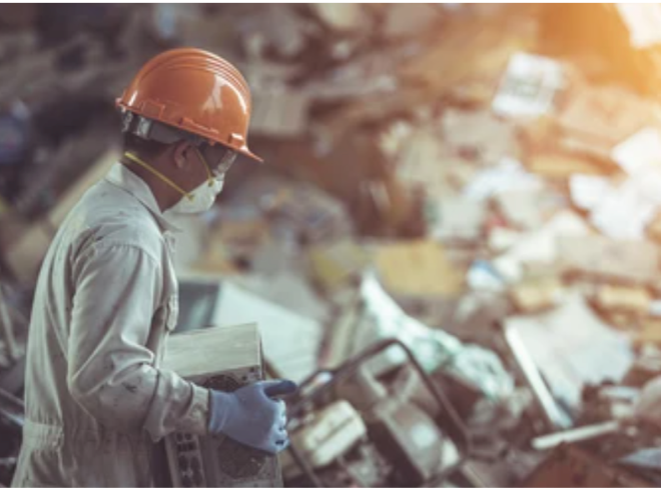
The 83% of electronic waste that was not recycled in 2019 would have either been thrown into landfill or shipped off to other countries and dumped there. For example, the commercial district of Agbogbloshie in Ghana is one of the world’s principal recipients of such waste. E-waste arrives here in its hundreds of thousands of tonnes and has a detrimental impact on the health of the informal workers that are responsible for sorting it. Wishing to clearly emphasise the severity of the matter, Stephen Sicars, an environmental director at the United Nations’ Industrial Development Organization, said that “E-waste is a growing global challenge that poses a serious threat to the environment and human health worldwide”.

ELECTRIC CARS AND E-WASTE

Unless we make a change now, EVs will create an unprecedented volume of E-waste

Unfortunately, with the world reaching unprecedented technological heights, this problem is only going to get worse. In the automotive industry in particular, E-waste is going to be especially troublesome. The global efforts to lower vehicle emissions have seen many countries committing to only producing electric vehicles. In theory, this is good news, but it doesn’t take electronic waste into account; as more EVs are manufactured, the greater the scope is for more E-waste to be produced.

Part of the reason why so little of this waste is recycled is because of its complex structure. The metals, magnets, wiring, and remaining electrical current make it difficult – and even unsafe – to recycle. This is particularly the case with an electric motor, which powers electric vehicles. The motor that is used in the majority of these cars is called a permanent magnet machine, but these require rare earth metals such as neodymium or dysprosium, which can be magnetised to become permanent magnets. On top of this, these motors need a copper coil to enable an electric current to rotate the magnet and create mechanical power.

THE SOLUTION?

We deliver electric motors that are fully recyclable

The process of recycling one of these electric motors is complicated, requiring the removal of the copper coil and magnets before the motor can be recycled. This is not a simple task, and is often deemed too expensive to even attempt, so electric motors are just being thrown into landfill. As was the case with the internal combustion engine, a more environmentally sustainable alternative is required.

AEM’s technology is the solution. Using no rare earth metals and replacing copper with aluminium, our electric motors can be put straight into an arc furnace and melted down, making them fully recyclable and removing the contribution to e-waste. This technology promises to make a huge mark in the automotive industry’s mission to become more environmentally sustainable.

If not a permanent magnet motor, then what?

HISTORY OF PERMANENT MAGNET MOTORS

The electric vehicle industry has been built on these motors

Permanent magnet machines have been the traction motor of choice for OEMs since the first modern electrified vehicles hit the roads in the late 1990s. At that time, engineers favoured the permanent magnet motor for its efficiency, relative power density and simplicity, and since then an entire electric vehicle industry has grown up around these machines.

The engineers working on those early hybrid vehicles couldn’t have foreseen the issues that mass production of EVs containing permanent magnet motors could cause. Nor could they predict our insatiable need for personal electronics and the pressures these two trends would place on rare earth metal production or levels of electronic waste.

THE PROBLEMS

Permanent magnet motors are environmentally and financially unsustainable

But now we do know the realities of mass-producing permanent magnet traction motors for a burgeoning electric vehicle industry. For each permanent magnet traction motor produced, around 2kg of rare earth material is needed, costing around $200 – although that price is incredibly volatile (it increased 240% in the year up to March 2021).

That means that the production of each traction motor can create around 3kg of radioactive waste and up to 56kg of CO2. Those worrisome figures only become worse when you consider that some forecasts suggest we’ll be producing 128 million EVs per year within the next 20 years. Shockingly, if rare earth metal production keeps pace with this growth, it could be producing enough acidic sewage to fill an additional 21,000 Olympic-sized swimming pools every year.

ALTERNATIVE SOLUTIONS

So far attempts to remove magnets has meant a compromise on performance and range

So, it’s clear that a different, magnet-free solution is needed for EV traction motors, and fast. But there’s a good reason permanent magnet machines have been favoured over other existing motor technologies so far.

True, some vehicle manufacturers have incorporated induction motors into their electric cars instead, but the result of using this less power-dense solution has meant heavier vehicles and less predictable real-world range.

AEM’S TECHNOLOGY

A new motor technology that is more sustainable, more efficient and higher performing

That’s where AEM’s technology comes in. A semi-sinusoidal machine, AEM’s technology changes how electricity is fed into the coil and swaps the permanent magnets in the rotor for electrical steel.

The result is a motor that is not only more sustainable to produce and dispose of than the permanent magnet machine, it is also more efficient and power dense, while even providing significant safety benefits.

So you see, there really is an alternative to the permanent magnet motor that not only provides performance advantages, but stops us from falling into yet another environmental trap for future generations.

Faster, Further, Lower Cost, Greener

Why AEM’s motors outperform the rest of the market

AEM’S UNIQUE MOTOR TECHNOLOGIES

Background

AEM’s electric motors are unlike anything else on the market, offering a unique approach to achieving sustainable traction. HDSRM and SSRD traction motors eliminate rare earths, are uniquely recyclable and offer vehicle range improvements over competitors.

This blog describes how AEM’s motors allow customers to go Faster and Further whilst being Lower Cost and Greener.

FASTER

How AEM’s high speed motor technology enables very high-performance vehicles

AEM’s SSRD traction motor is designed to operate at 30,000 revolutions per minute, significantly faster than any motor currently in volume automotive production.

This rotational speed was originally selected as it was shown to form the basis for the most cost-effective possible EV powertrain, however experience has now shown that it can also enable the world’s highest performance electric cars.

Work with partner Bentley has shown that SSRD will allow a high-performance electric vehicle to operate up to the highest speeds without a need for a complex transmission. Removing the transmission makes the vehicle lighter and increases acceleration, to further key components of the highest performance vehicles.

FURTHER

How AEM’s traction technology allows AEM powered vehicles to go further on a single charge

A major commercial vehicle customer has reported that the expect AEM’s HDSRM commercial vehicle traction motor to increase their vehicle range by 10%.

A major passenger vehicle OEM has reported that AEM’s SSRD traction motor will extend their cars range by 15%.

Based on AEM’s modelling and testing to date, this increase in range can be attributed to several key technology factors:

  • AEM’s fundamental motor technology has inherent efficiency advantages through their physics, this is coupled with a trade secret design approach which optimises the motors to meet specific customer’s needs
  • AEM’s compressed aluminium windings reduce high speed losses in the motor, allowing the motor to operate efficiently across the full speed range
  • AEM’s ‘efficiency boost’ technology, used in dual motor systems, allows a single motor to be switched off when it is efficient to do so; this has the effect of significantly increasing the peak efficiency region of powertrain operation

LOWER COST

Why AEM’s Motor technology is inherently lower cost than the competition

Simply put, AEM’s motors eliminate the need for the two most expensive materials used in motor manufacturing; rare earth magnets and copper. As well as achieving the sustainability benefits of eliminating these materials, lowest manufacturing cost is also a significant benefit.

Rare earth magnets are the single most expensive material in a motor, with around 2kg used in a standard traction motor and costing around $100/kg as a base price. Rare earth price volatility however means that even higher base costs can be driven by market forces. However, the benefits go further than this; magnets are very challenging to handle during manufacture. Metals particles want to stick to them, hands may be injured between them, and other metals want to be magnetised by them (potentially ruining production equipment). AEM’s technology eliminates all of these problems.

Further, use of AEM’s compressed aluminium conductors reduces motor conductor costs by circa 90%.

Additionally, there are even greater benefits. AEM’s motors are designed to reduce the overall cost of the electric powertrain. The SSRD motor was initially developed as part of a programme called “Low Cost Electric Drivetrain”, designed to reduce not just the cost of the motor but the system overall. Additional savings are made by ensuring that the motor can:

  • Be driven by cost effective power electronics; SSRD uses at least as cost-effective power electronics as the industry standard interior permanent magnet motor
  • Reduce the size of the battery needed to drive the vehicle; as has already been discussed under “Further” in this blog AEM’s motors offer the potential for up to 15% increase in vehicle range
  • Operate with a lower complexity and therefore lower cost transmission; SSRD is designed to work with a simple, low cost transmission as is discussed under “Faster”.

GREENER

How AEM’s motors are designed to be the world’s most sustainable

AEM was founded in order to develop electric motor solutions which offer true environmental sustainability, something not currently offered in the market.

To achieve this AEM has taken a number of steps in order to make it products as sustainable as possible:

  • HDSRM and SSRD products do not use rare earth magnets, removing the single least sustainable material from the electric motor
  • In production, HEAD will use recycled rare earth magnets; recovered from scrap sources such as used hard disk drives, these magnets are recycled to minimise environmental footprint
  • All motors will use Aluminium Motor windings; this dramatically improves motor recyclability at the end of vehicle life by allowing the motor to be recycled as part of the standard steel recycling root. This is impossible for conventional motors as copper is a contaminant in the steel recycling process
  • AEM seeks ways to improve the sustainability of its operations. For example, waste heat is recovered from motor validation testing in order to heat the AEM factory unit