Copper – where things stand

No secret has been made of the global ambition to reach net-zero emissions and greater sustainability. On the surface, this is an excellent and highly necessary initiative, but it hasn’t come without its challenges.

One of the greatest challenges we are beginning to understand the true scale of, is the growth in demand for raw materials; from neodymium to cobalt to copper. Copper is central to the new technologies being created to meet the world’s environmental goals, with The Institute for Human Rights and Business predicting there will be a 300% rise in demand for copper by 2050. This equates to 60 million tonnes of the metal being required every year, but at what cost?

THE COSTS OF COPPER

As demand increases, so does the environmental, human and financial cost

Up until now, the demand for copper has remained at a manageable level. The capacity to recycle the copper in circulation to meet demand has been hugely beneficial, as it has reduced the need to mine for it. Copper mining has a known detrimental impact on people’s health and the natural environment, leading to land degradation, deforestation, and water and air pollution. Unfortunately, with demand on the rise, recycling the existing copper will no longer be sufficient, leaving no option but to greatly increase the levels of mining.

We must also consider the financial cost of copper. In March 2022, prices spiked for the third time in less than a year, as copper stocks approached historically low levels of just 200,402 tonnes – that does not even cover three days of global consumption at the current rate. As the world risks ‘running out of copper’, CNBC reports that prices could rise to $20,000 per tonne in the next five to ten years, which when combined with the expected rise in demand begins to paint a very costly picture.

COPPER AND THE ELECTRIFICATION REVOLUTION

This is a scaling problem driven by the rise of electric vehicles

Since Michael Faraday discovered electromagnetic induction using copper coils over 200 years ago, copper has been the metal of choice for an electrical conductor. It is, therefore, no surprise that copper is at the very core of the electric revolution. Electric vehicles are key in the global drive towards net-zero, but their batteries, motors, electrical components and even charging equipment all use copper to function.

In electric vehicles, traction motors contain copper coils that an electric current passes through to generate mechanical energy that will spin the motor and propel the vehicle. This contributes to the average battery-electric car containing 83kg of copper, which is four times that used in petrol and diesel cars.

With governments across the world setting deadlines to ban the sale of petrol, diesel, and even hybrid vehicles, battery-electric vehicles will begin to monopolise the market. According to the Financial Times, if electric vehicle sales hit the expected 40% increase by 2030, around eight times more copper will be required for annual vehicle production.

Is this a problem?

The argument goes that copper is one of the most highly recycled metals, with around two thirds of all copper mined still being used today. However, demand has never been this high, and the copper in electric motors is extremely difficult and expensive to extract for recycling, which means the motors, and the copper in them, often just ends up in landfill. As EV production ramps up, so does the amount of copper being demanded but not recycled. Unless an alternative is found, more copper will have to be mined, but is this really a sustainable future?

A DIFFERENT FUTURE

How we can support the sustainable growth of electric vehicles

We see a different future. As experts in designing and manufacturing the most sustainable electric motors, we have developed an alternative technology that will allow us to remove copper from our next generation motors. AEM has designed highly compressed aluminium windings to replace traditional copper coils that maintain the performance characteristics of the electric motors, but in a more efficient and sustainable way.

It is undeniable that copper will have a huge role to play in the future of the electric revolution, and required supply will need to greatly increase to meet the demand. However, it is important to us at AEM that we are always striving for the most sustainable solutions, why else are we all investing so much in electric vehicles if not to ensure a greener future?

Electric vehicles – the growing picture

It’s difficult to ignore the increasing number of electric vehicles (EV) arriving onto our streets. In the UK, electric vehicle licence plates boast a strip of green as a sign to others that it generates zero tailpipe emissions. From fuel stations to supermarket car parks, spaces are being handed over to electric vehicle charging points.

The electric vehicle revolution has begun. The question is, at what rate is it expected to grow and at what point will we live in a majority EV world?

SCALING UP

The demand is only set to grow

According to data from the SMMT, the industry body that monitors registrations in the UK, battery electric vehicle sales grew by more than 26% last year and, in doing so, secured around a quarter of the market share. Naturally, it would be a bold and somewhat unrealistic prediction to say that, by continuing to grow at this rate, all cars sold in the UK will be battery-electric by 2025. But plans put in place by the UK Government will see the sale of new non-hybrid internal combustion vehicles banned by 2030.

Looking at the global picture, the expected growth of electric vehicles over the next decade is more modest but by no means insignificant. Research by BloombergNEF suggests that, by 2025, worldwide EV sales are expected to reach 14 million per year, with a global fleet totalling 54 million vehicles.

SUSTAINABILITY IS CRITICAL

Higher demand leads to a higher environmental burden if technology doesn’t change

There’s still a considerable amount of uncertainty beyond this point. Factors including the price of components, infrastructure viability and governmental incentives will undoubtedly impact the speed of adoption. If the predictions are correct and we’re on track to reach annual sales of 14 million EVs globally by 2025, in the shorter term we all need to play a part in delivering sustainable electrification collectively. If not, we risk causing more environmental damage.

Our semi-sinusoidal motor technology is part of the solution. By removing the rare-earth magnets from our motors, we’re also able to mitigate the need for finite materials sourced by dirty mining practices and traded in volatile markets.

Clearly, we’re still several years away from understanding the true EV endgame. In a decade or so, it will be interesting to reflect on how the industry’s predictions were reflected in reality. Regardless, we hope that others will join us in ensuring that the journey is made with true sustainability at its core.

Our motor technology explained

As has been established, electric vehicles (EVs) are not without their drawbacks. Recycling issues and the modernisation of rare earth mining practices are big obstacles that need to be overcome in order to ensure a sustainable transition to implementing electrified transport. To compound this, any alternative solutions put forward are challenged with the need to be at least as powerful, torque dense and efficient as existing technologies.

The electric motor is a critical element of the EV powertrain, and must not be overlooked in the search for greater sustainability. For years now, the conventional permanent magnet machine has been the motor of choice for automotive manufacturers, and has been regarded as the most effective solution for electric vehicles. We have already established the environmental issues that this technology brings to the fore, and this has not been lost on vehicle manufacturers, who are now actively seeking rare-earth free alternatives.

The problem with this type of motor is not just environmental, but its relative cost and complexity. However, as some manufacturers move to rare-earth free options, they are finding themselves compromising efficiency and performance, and in some cases, their solutions are even less sustainable due to their increase in size and the increased amounts of alternative materials they use.

Step forward AEM. Our solution takes away these concerns, removing rare earth magnets from the motor design and simultaneously improving efficiency, increasing performance and lowering cost.

How? Well, we’ve replaced the rotor magnet with electrical steel, and the copper coils in the stator with highly compressed aluminium windings. As we’ve established, this has a hugely positive environmental impact, as our choice of materials means our motor is fully recyclable at end-of-life, leading to less e-waste.

The benefits of removing magnets from the motor also mean that operating risks are reduced, with no chance of short circuit currents or the high voltage spikes which can be experienced with permanent magnet motors. We can therefore ensure safer failure modes should something go wrong. In addition, our magnet-free motors have no risk of demagnetisation, as temperatures increase at higher rotational speeds, which allows for our motors to run much faster, whilst also enabling a simpler thermal management system for the vehicle.

In terms of cost, it is expensive to use rare earth magnets in motors, with each motor containing at least $200 worth of magnets alone. The volatile supply of neodymium – the main rare earth metal used in electric motors – also means there is significant scope for the price to increase much further. From February 2020 to February 2022, the cost of neodymium has risen by 312%, with one kilogram now costing more than $236, compared to $42 just two years ago. Put simply, vehicle manufacturers will find it difficult to plan the scale-up of electric vehicles in the numbers required when the cost of a key component can be so volatile.

And then there’s package efficiency. The faster a motor spins, the more power dense it can be. Typically, this faster spin will lead to problems with rare earths, but our motor is, of course, a little bit different. Without magnets, we can make the motor spin twice as fast, making it easier to package and lighter in weight. The fact that our motors are inert when not being driven enables the vehicle to coast. This has led to an increase in efficiency of up to 12% being reported by our customers over conventional permanent magnet motors throughout a typical vehicle drive cycle.

As you can see, our solution solves many of the problems that are found in producing electric motors. In order for electric vehicles to be as sustainable as possible, change needs to embraced, and if it is, then a truly green future can be a reality right now.

Find out more about our products.

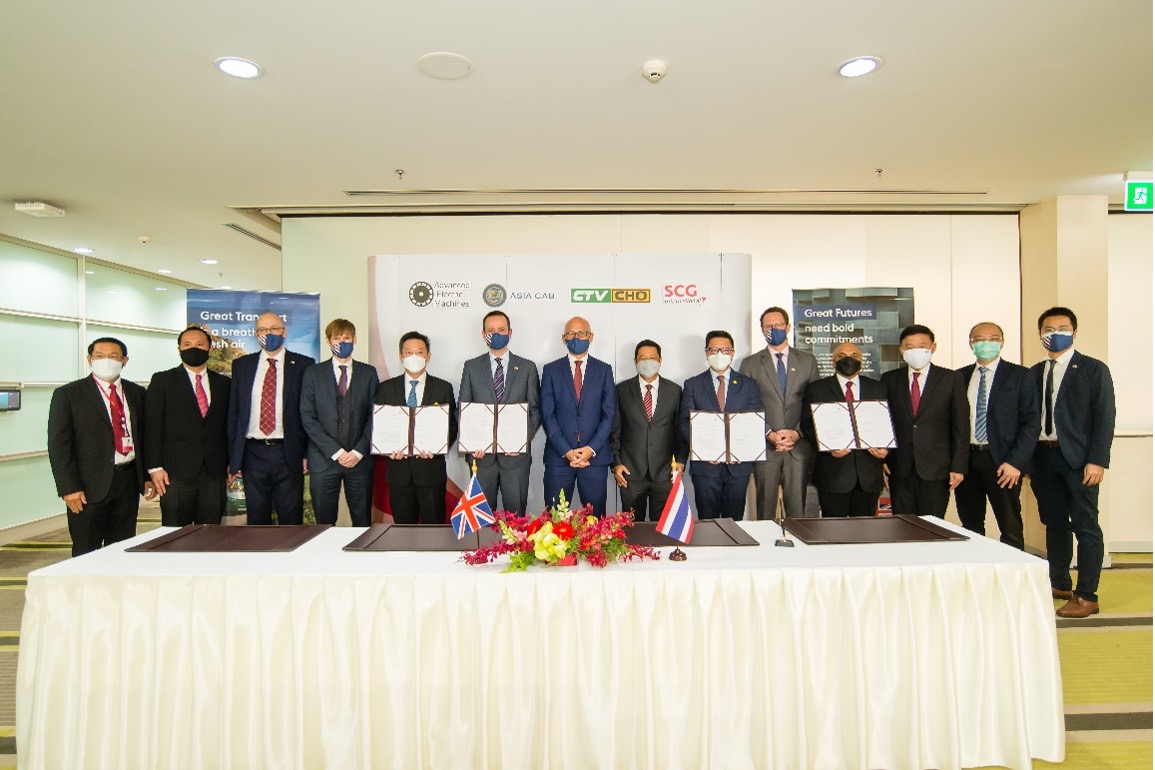
SCG International joins Cho Thavee and Asia Cab in Signing Thai MOU with AEM

SCG International Corporation has signed a landmark Memorandum of Understanding (MOU) with Advanced Electric Machines Ltd (AEM), Cho Thavee Public Company Limited (CTV), and ASIA CAB Co to develop innovative solutions that will enable internal combustion engined cars to be electrified using AEM’s sustainable motors.

Advanced Electric Machines Ltd (AEM) is a leading manufacturer of sustainable electric motors based in the United Kingdom. The company designs and manufactures rare-earth magnet-free EV motors for the automotive and transportation sectors, leveraging its materials, manufacturing, and design expertise to deliver the most efficient and cost-effective solutions. AEM’s sustainable motor has registered several international patents on its proprietary technology since 2016.

James Widmer, CEO of Advanced Electric Machines Ltd (AEM), said: “The MOU represents a significant strengthening of our position in the Asian market. We are delighted to have SCG International as a partner, as it allows us to play a role in building a sustainable electrification future for Thailand and Southeast Asia. The latest order from Asia Cab is testament to this, and we look forward to working with them to develop our future electrified range.”

In line with its vision ‘To Be The Most Trusted International Business Partner’, SCG International aims to leverage its international business expertise in this collaboration and promote clean mobility, complying with ESG (Environmental, Social, Governance) principles.

“The collaboration of three Thai parties (CTV, Asia Cab, and SCG Intl) with AEM will not only bring superior technology to the automotive market, but in line with SCG Group’s policy, it will also accelerate the adoption of Clean Mobility,” said Abhijit Datta, Managing Director of SCG International Corporation Co., Ltd. “SCG International values sustainability and hopes that our EV solution platform will contribute to Thailand’s sustainability goals. We will provide our customers a one-stop service with smart, affordable, and worry-free solutions spanning the vehicle’s life cycle.”