AEM Leads Project To Establish UK Supply Chain For EV Drivetrains

  • AEM to lead Coil to Core: Supply Chain for Net Zero CO2 (COCO2) project
  • The COCO2 project will aim to establish a PEMD supply chain in the UK
  • The company’s involvement in the initiative demonstrates its commitment to achieving key industrial and environmental goals

Advanced Electric Machines (AEM) will lead the Coil to Core: Supply Chain for Net Zero CO2 (COCO2) project. The project, which will run from January 2022 to January 2025, will seek to develop a Power Electronics, Machines and Drives (PEMD) supply chain in the UK.

The newly established supply chain will develop cost-effective material supply and manufacturing of new high strength steels using innovative mass production processes. This will deliver patented lamination designs that can be stacked into novel rotor and stator sub-assemblies, allowing the mass production of more efficient and sustainable electric machines. These machines can be used across a wide range of applications in the transport, energy, and industrial sectors.

Throughout the project, AEM will be working alongside partnering organisations such as Tata Steel, the Centre for Process Innovation (CPI), and Coventry University. The project is funded by the Driving the Electric Revolution challenge at UK Research and Innovation.The project team’s goal is to establish a supply chain with a clear end-to-end route to market for electric vehicle drivetrains. To ensure the supply chain is both attractive to the market and profitable, the team will also undertake production costing and value chain analysis.

The COCO2 project is a clear demonstration of AEM’s commitment to achieving key industrial and environmental goals within the UK. Among these is a pledge to support innovation by developing a versatile range of materials, processes, and sub-assemblies. This innovation will produce the basis of more efficient and more sustainable electric machines that exclude the use of rare earth materials and copper.

In accordance with the UK’s drive towards net zero, sustainable routes to electric motor production will be established throughout the project. This, coupled with the development of sustainable electrification solutions, ensures that the initiative falls in line with the Government’s target of achieving a green industrial revolution in the transport, energy and industrial sectors.

James Widmer, CEO of AEM, said: “The growth in the electric vehicle market in recent years has shone a light on the need to bolster the electric vehicle driveline supply chain. The Coil to Core: Supply Chain for Net Zero CO2 project will see AEM and our partners establish a clear path for the mass production of efficient and sustainable electric machines. As a result, the transport, energy and industrial sectors will have an array of more environmentally viable options at their disposal.”


Tackling the sustainability of power electronics

It wouldn’t be overstating it to say that without power electronics the modern world would grind to a halt.

Power electronics has a role in just about every electrical engineering function that you can imagine. It’s in your mobile phone, it’s in your electric car (if you have one), and there will be a multitude of electronic devices in your home that rely on power electronics.

The question, then, is what on earth is power electronics?

Power electronics uses semiconductor technology to control the flow of electrical energy from a source, such as a battery, to a load, such as a traction motor. In other words, it is a sort of ‘invisible’ technology that makes electrical systems work.

Power electronics is so widely used because it is an incredibly efficient way of converting one form of electrical energy into another. And so it is that these complex pieces of technology are going to be in high demand as we embark on the express EV scale-up that the industry is bracing itself for.

The future of power electronics

Now, there are a number of key technological drivers for power electronics in today’s market: reduced costs, increased efficiency, increased power density, simple and flexible application, environmental tolerance, and life cycle.

The unique challenge of designing power electronics, however, is that improving one design criterion may adversely affect another. For example, if you try to make a system more cost-effective, it might affect the size of the unit and therefore reduce the power density.

However, that’s not to say that the automotive industry shouldn’t strive for better. In an earlier blog, we looked at the global problem of e-waste, to which power electronics is, unfortunately, a contributor. To make progress, we need to develop power electronics that are more sustainable, more affordable, and highly resilient.

The challenge with sustainability is that power electronics systems are made up of a complex cocktail of polymers, ceramics, semi-conductors and metals like copper, aluminium and tin plus small amounts of precious metals such as silver and  gold. All of these materials have different lifecycles, and some are difficult or impractical to recycle.  

The three Rs

The industry’s success in overcoming this challenge will, to a large extent, depend on how it can deliver agains the ‘three Rs’.

Reduce, Reuse and Recycle.

Reduce means using less raw material and less energy in our manufacturing. It means using recycled material where possible, replacing difficult-to-recover materials if we can, and making products that are even more energy-efficient.

Reuse means designing power electronics for a longer life, as well as designing them for reuse and remanufacture. Central to this is making systems that are easier to dismantle so that valuable parts can be recovered.

And Recycle simply means we become less reliant on materials that cannot be recovered and recycled.

At Advanced Electric Machines, we strongly believe that this is the path we must take, and the time to accelerate change is now.

The messy business of rare-earth metals

If you’ve followed our work over the past couple of years, especially during last year’s COP26 summit, you’ll know that we’re not afraid to draw attention to the volatile world of rare-earth metals. In fact, we’ve been banging the drum of discontent ever since we started AEM in 2017.

As a bit of background, most electric vehicles on our roads today use permanent magnet motors. This is because it’s a proven technology and was, until now, thought to be the most efficient means of powering a vehicle. The issue we have with permanent magnet motor technology is that each unit uses some 2kg of rare earth magnets.

THINGS NEED TO CHANGE

There are grave costs to using rare earth metals

The mining of rare earth metals is, in short, damaging to the environment and harmful to those involved. For every single tonne of rare earth metals mined, it’s been reported that up to 1.4 tonnes of radioactive waste can also be produced. Mining 12 tonnes can generate enough acid-containing sewage water to fill an Olympic-sized swimming pool. If you compare rare earth mining to steel production, mining rare earths creates over 11 times more CO2 for every tonne of steel manufactured.

It’s not just the social and environmental issues of rare earth mining that need to be considered. As their name suggests, rare earth metals are only available in low quantities globally due to the highly complex process involved in their extraction. And scarcity, unsurprisingly, translates into a premium price point and a volatile trading market. Between March 2020 and March 2021, the cost of neodymium (a key element in electric motor magnets) increased by 240%. How can vehicle manufacturers scale their models with fluctuations as dramatic as that?

REMOVING RARE EARTHS

The only way to eliminate this problem is to eliminate the rare earths in motors

It’s hard, however, to criticise the practice when it seems that no viable alternative is available. That’s why we’ve spent several years developing our own semi-sinusoidal motor technology that does away with the rare earth magnets that limit an electric motor’s scope.

By removing the magnet in our design, AEM motors can spin twice as quickly as a permanent magnet motor. This makes it up to 12% more efficient and kinder to the environment. We’re also exchanging the copper windings for a compressed aluminium design. It means that our motor is made almost entirely out of steel and aluminium – both of which are easy to recycle through existing channels.

Thankfully, we’re starting to see the awareness around rare-earth mining grow. We’ve seen it not only amongst the major automotive manufacturers and their engineers, but with the rising number of environmentally conscious product buyers, too. We all have an appetite to go green, but it will be all in vain if we don’t remember our duty to do so sustainably.

A Global Issue

Electronic waste is an increasing problem that no one is talking about

Consider the efforts that have gone into properly disposing of plastic waste. Years of campaigning to rid the world of unnecessary and damaging landfill led to a reformed approach to recycling, with plastic now widely recycled. These efforts that went into making the recycling of plastic waste a global concern massively impacted public attitudes.

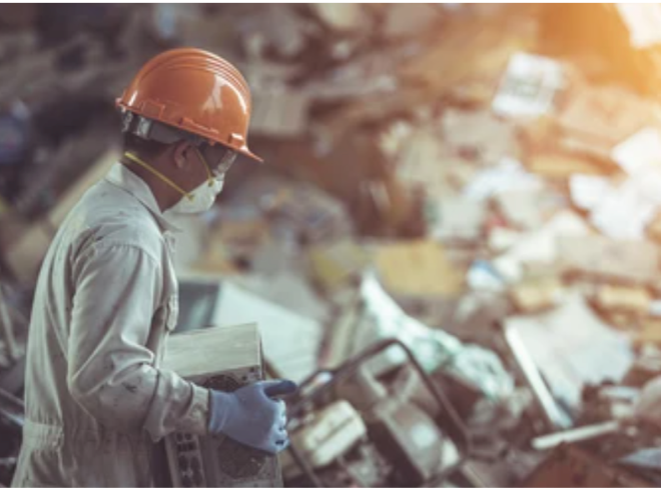
Now, generally speaking, electronic waste – or E-waste – is not typically at the forefront of your mind when it comes to landfills and recycling, but, as with plastic, it is a global issue. In 2019 alone, a whopping 53 million tonnes of E-waste was registered, with only 17% of this recycled. Compare this to the recycling rate of plastic in the UK in 2018, where 43.8% of plastic packaging waste was recycled, and you can see a stark difference. Perhaps, then, it is about time that we reassess how we deal with E-waste.

The 83% of electronic waste that was not recycled in 2019 would have either been thrown into landfill or shipped off to other countries and dumped there. For example, the commercial district of Agbogbloshie in Ghana is one of the world’s principal recipients of such waste. E-waste arrives here in its hundreds of thousands of tonnes and has a detrimental impact on the health of the informal workers that are responsible for sorting it. Wishing to clearly emphasise the severity of the matter, Stephen Sicars, an environmental director at the United Nations’ Industrial Development Organization, said that “E-waste is a growing global challenge that poses a serious threat to the environment and human health worldwide”.

ELECTRIC CARS AND E-WASTE

Unless we make a change now, EVs will create an unprecedented volume of E-waste

Unfortunately, with the world reaching unprecedented technological heights, this problem is only going to get worse. In the automotive industry in particular, E-waste is going to be especially troublesome. The global efforts to lower vehicle emissions have seen many countries committing to only producing electric vehicles. In theory, this is good news, but it doesn’t take electronic waste into account; as more EVs are manufactured, the greater the scope is for more E-waste to be produced.

Part of the reason why so little of this waste is recycled is because of its complex structure. The metals, magnets, wiring, and remaining electrical current make it difficult – and even unsafe – to recycle. This is particularly the case with an electric motor, which powers electric vehicles. The motor that is used in the majority of these cars is called a permanent magnet machine, but these require rare earth metals such as neodymium or dysprosium, which can be magnetised to become permanent magnets. On top of this, these motors need a copper coil to enable an electric current to rotate the magnet and create mechanical power.

THE SOLUTION?

We deliver electric motors that are fully recyclable

The process of recycling one of these electric motors is complicated, requiring the removal of the copper coil and magnets before the motor can be recycled. This is not a simple task, and is often deemed too expensive to even attempt, so electric motors are just being thrown into landfill. As was the case with the internal combustion engine, a more environmentally sustainable alternative is required.

AEM’s technology is the solution. Using no rare earth metals and replacing copper with aluminium, our electric motors can be put straight into an arc furnace and melted down, making them fully recyclable and removing the contribution to e-waste. This technology promises to make a huge mark in the automotive industry’s mission to become more environmentally sustainable.