AEM urges UK automotive leaders to break rare-earth dependency before EV transition stalls

  • Export controls and concentrated supply chains put UK EV production and net zero targets at risk
  • Proven rare-earth-free motor technology offers an immediate, lower-impact alternative
  • “The technology to remove this vulnerability already exists. What’s missing is the urgency to adopt it,” Dr James Widmer

The UK automotive industry is sleepwalking into its next major supply chain crisis, according to Advanced Electric Machines (AEM), which is urging manufacturers and policymakers to act now to eliminate the sector’s reliance on rare earth materials before it compromises the electric vehicle transition.

In a new white paper released today, AEM warns that the widespread use of rare-earth permanent magnet motors in electric vehicles has created a single point of failure comparable to the semiconductor shortage that crippled global car production during the COVID-19 pandemic. Unlike semiconductors, however, this vulnerability is structural, worsening and already being exploited.

Recent export licensing restrictions on rare earth elements have forced production shutdowns across Europe, with manufacturers warning that further disruption is imminent. With one country controlling the vast majority of rare earth processing capacity, the report argues that the UK’s decarbonisation targets, automotive competitiveness and economic security are all now exposed to geopolitical, environmental and cyber risks beyond domestic control.

The white paper also emphasises that most electric vehicles rely on up to a kilogram of rare earths per motor, materials that are environmentally destructive to extract and increasingly subject to export controls. With the UK’s Zero Emission Vehicle (ZEV) mandate requiring 80% of new car sales to be zero-emission by 2030, AEM argues that current supply trajectories simply cannot support the required growth in EV production.

Crucially, the report challenges the assumption that rare earths are unavoidable. It sets out how proven, commercially deployed alternatives already exist. AEM’s rare-earth-free motor technology has accumulated more than four million kilometres in real-world operation across buses and light rail, delivering comparable performance, lower costs and significantly reduced environmental impact.

Lifecycle analysis cited in the report shows magnet-free motors can cut environmental impact by more than half compared to conventional permanent magnet designs, while also removing exposure to volatile rare earth pricing and geopolitically concentrated supply chains.

In tandem with these developments, the UK Government’s new Critical Minerals Strategy is a positive step in recognising the risks of highly concentrated supply chains, but AEM argues resilience will not be achieved by simply sourcing rare earths from different places. Where proven technologies exist that eliminate the need for critical minerals altogether, accelerating their adoption offers a faster, more secure route to meeting net zero targets and protecting the UK automotive sector from future disruption.

“We’ve been here before,” said Dr James Widmer, CEO and co-founder of Advanced Electric Machines. “The semiconductor crisis showed how quickly a hidden dependency can shut down production, damage confidence, and cost the industry billions. Rare earths represent an even greater risk because the dependency is deeper, the supply chains are more concentrated, and the disruption is no longer hypothetical. The technology to remove this vulnerability already exists. What’s missing is the urgency to adopt it.”

The white paper calls for immediate pilot programmes by UK manufacturers, coordinated supply chain risk assessments, and targeted government support to accelerate domestic production of rare-earth-free motors. It argues that establishing even partial independence within the next five years would materially reduce the risk of production shutdowns, missed climate targets and loss of consumer confidence in the EV transition.

To view the white paper in full, please visit: [LINK].

ENDS


About AEM

Advanced Electric Machines’ vision is to design and build the world’s most sustainable EV motors for the global automotive and transport sectors. It utilises its expertise in materials, manufacturing and design to ensure its solutions are not only more sustainable, but also more efficient and cost-effective.

Based in the Northeast of England, Advanced Electric Machines Limited was founded in 2017, when it was spun out from Newcastle University’s world-class electric motor research team, led by AEM’s CEO, Dr James Widmer, and CTO, Dr Andy Steven.

AEM technologies are covered by 46 international patents protecting their unique motor designs and manufacturing processes around the world.

Contacts:

Advanced Electric Machines

John Edden, Torque Agency Group

jedden@torqueagencygroup.com | +44 (0) 7403 640 213

Euan Antona, Torque Agency Group

eantona@torqueagencygroup.com | +44 (0) 7702 334 887

The Next Generation of HDRM motors

Next generation UK-manufactured motor reaps efficiency gains for heavy duty applications

Advanced Electric Machines (AEM) sets new standards in electric motor efficiency with next-generation solution

  • New HDRM300C motor brings stronger performance and greater efficiency to AEM’s commercial vehicle-focused motor
  • Revolutionary compressed coil technology achieves over 80% conductor slot fill rate compared to conventional 60%
  • Enhanced thermal management and cooling design delivers superior continuous performance; higher top speed adds greater flexibility for customers
  • Samples available from March, production due to commence in Q4 2025

Advanced Electric Machines (AEM), the UK-based manufacturer of sustainable, magnet-free electric motors, has unveiled the second generation of its popular solution for heavy duty and commercial vehicle applications. HDRM300C strengthens AEM’s position as a leading producer of rare-earth free motors and provides customers with an enhanced motor that offers stronger performance and greater efficiency.

Building on the success of its HDRM150 motor, where AEM first developed and validated its innovative coil compression technology, the HDRM300C represents a major advancement in electric motor design, achieving industry-leading conductor slot fill rates exceeding 80%. This proven technology, now evolved and scaled up from the smaller HDRM150, delivers measurably better power density and efficiency compared to conventional wire layouts that typically achieve less than 60% fill rates.

“The HDRM300C represents more than just an incremental improvement in motor technology,” says James Widmer, CEO of Advanced Electric Machines. “By combining our patented coil compression technology with enhanced thermal management and improved speed capabilities, we’re delivering a motor that sets new benchmarks for efficiency and performance. For the transportation industry, this means more capable electric vehicles that are more cost effective to operate and maintain.”

The practical benefits extend beyond pure performance. The HDRM300’s increased speed capability provides greater flexibility for system integration across diverse applications. New plug-in connectors have replaced traditional gland fittings, simplifying the installation and maintenance process, while maximising overall reliability. Internal components, including upgraded bearings and robust busbar connections, have been strengthened to support the motor’s higher operational speeds.

An improved motor cooling system, which works similarly to a car’s radiator, allows the machine to work harder for longer without overheating. This is particularly important for commercial vehicles, where consistent performance throughout the day is crucial. For fleet operators and vehicle manufacturers, this translates to vehicles that can carry heavier loads, climb steeper hills, and operate in more demanding conditions without compromise.

Sample units will be trialled with select partners from March 2025, with full production scheduled to commence in Q4 2025. The launch represents a significant milestone in AEM’s mission to revolutionise electric motor technology and establish new standards for sustainable transportation.

*Please note the omittance of ‘S’ in the product name (formally HDSRM). This is a product line rebrand and also applies to AEM’s HDRM150 motor.

About AEM

Advanced Electric Machines’ vision is to design and build the world’s most sustainable EV motors for the global automotive and transport sectors. It utilises its expertise in materials, manufacturing and design to ensure its solutions are not only more sustainable, but also more efficient and cost-effective.

Based in the Northeast of England, Advanced Electric Machines Limited was founded in 2017, when it was spun out from Newcastle University’s world-class electric motor research team, led by AEM’s CEO, Dr James Widmer, and CTO, Dr Andy Steven.

AEM technologies are covered by 46 international patents protecting their unique motor designs and manufacturing processes around the world.

Contacts:

Advanced Electric Machines

John Edden, Torque Agency Group

jedden@torqueagencygroup.com | +44 (0) 7403 640 213

Euan Antona, Torque Agency Group

eantona@torqueagencygroup.com | +44 (0) 7702 334 887

Why 2023 could be the watershed year for sustainable electrification

With the demand for electric vehicles set to increase next year, and the legislative mandate to stop ICE sales growing nearer, we think it’s inevitable that 2023 will see sustainable electrification become a major topic of discussion.

Though it’s widely accepted and acknowledged that battery manufacturing can be an environmentally damaging practice, the manufacturing of other EV powertrain componentry can be similarly impactful.

Permanent magnet motors, the mainstay of electric vehicles to date, utilise magnets containing rare-earth metals. These are in finite supply and are harmful to extract. It has been reported that, for every tonne of rare earth metals mined, 1.4 tonnes of radioactive waste can be produced.

Of course, we’re no strangers to the topic. Right from the get-go, we have said that electrification has to offer a solution – not create a problem. Our visit to COP26 in November 2021 was testament to this. Alongside David Thackray from Tevva and Professor Allan Walton of Hypromag, our team highlighted the environmental costs associated with the manufacturing and recycling of a legacy electric vehicle.

Part of the reason we feel that 2023 will mark a turning point in EV sustainability is because consumer awareness of these environmental issues is growing. We’re starting to see a noticeable uptick in the number of OEMs looking to specify equipment that mitigates the use of rare-earth metals.

Our sustainable semi-sinusoidal motor solution differs from other magnet-free motor technology. Other magnet-free motor technologies haven’t been successful due to poor efficiency and performance, with them often having to rely on increased use of other unsustainable materials. Conversely, AEM motors can meet, if not exceed, the performance and efficiency of PM motors whilst still reducing our environmental footprint.

The main reason permanent magnet motors have been long favoured is due to their efficiency compared to an induction set-up. We’ve been able to engineer our machines to be even more efficient than a permanent magnet motor, without needing the damaging materials. What’s more, it’s safer to operate and easier to recycle.   

Today, it’s widely appreciated that there is a need for electrification. But it’s our collective duty and responsibility to do so sustainably.

A rare-earth free, efficient future for our railways

Electric motors are everywhere. Pretty much everything manufactured or engineered in the last 60 years will have benefitted from their involvement. They build our homes, our workplaces, the roads on which we drive, and the smartphones in our pockets – without electric motors, the world would be a very different place.   

Our high societal dependency on electric motors is, naturally, good news for us at AEM. It means that we have the scope to deploy our semi-sinusoidal technology in a multitude of different sectors and applications. So far, our focus has been on supporting the automotive sector. But, behind the scenes, our technology is also being used to help repair and maintain the UK’s railways.

An electrified railway

The rail industry, both light and heavy, is a major consumer of electric motors. Though many of our routes are electrified in the UK, other countries around the world operate electric infrastructure almost exclusively.

Electrified track needs electric locomotives, multiple units and trams, each utilising traction motors. Even in combustion-engined trains, it’s become common for manufacturers to adopt a high-efficiency ‘diesel-electric’ model. This sees the train or locomotive’s engines used to generate electricity, rather than drive the wheels. The electricity is then fed to traction motors to provide the motion.

Then, you’ve got a broad array of infrastructure maintenance equipment, such as tamping units, road-rail vehicles and catenary installation machines. All are likely to either make use of electric powertrains in the near future if they aren’t already. 

Same motors, same issues

When it comes to pre-existing motor technology, the rail industry suffers from the same issues as the automotive sector. Where permanent magnet technology is deployed, predominantly on maintenance machinery, the motors rely on rare-earth permanent magnets. These use finite metals in limited supply and are environmentally damaging to extract and process.

Induction motors are more commonplace on locomotives and multiple units, but these have their weaknesses, too. While they don’t use magnets like a permanent magnet machine, they are notably less efficient. The result is that more fuel is needed to achieve the required tractive effort.   

AEM’s electric motor technology is both rare-earth free and even more efficient than a permanent magnet machine. Our design swaps a permanent magnet or induction design for an electrical steel rotor. Not only does this make it more sustainable to manufacture and easier to recycle, but it has proven to be more power dense and safer to run.

Making inroads

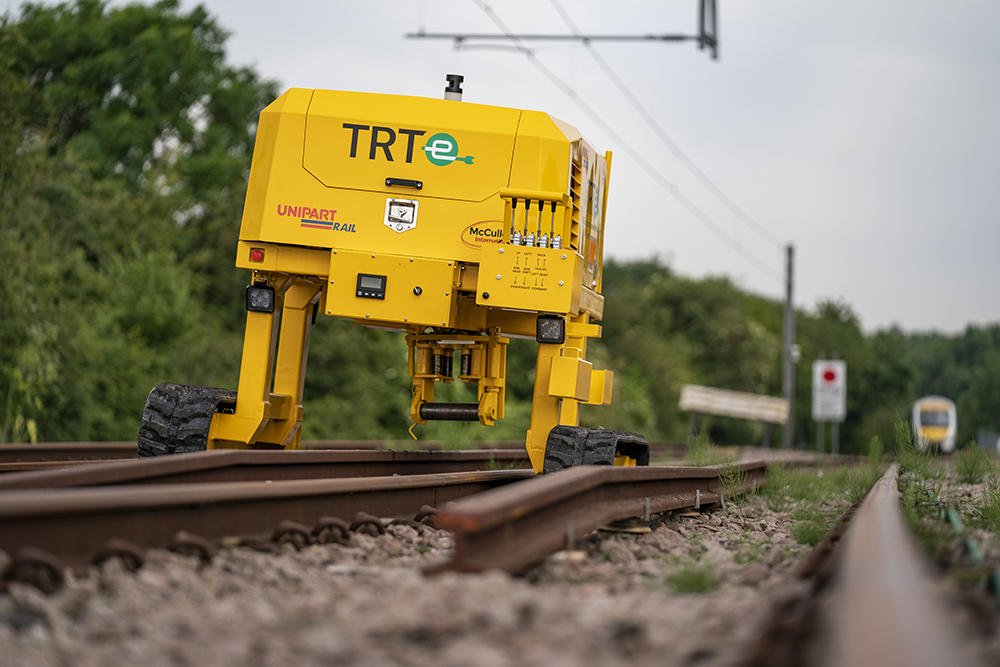
As we mentioned earlier, we have already taken steps to increase our presence in the rail sector over the last couple of years. Through our partnership with McCulloch Group and Unipart Rail, we have provided the electric motors for the industry-changing TRT-e – a zero-emissions Trac Rail Transposer. The vehicle is used to move sections of the railhead during track engineering works.

TRT-e has been in regular use with Network Rail, demonstrating considerable noise and emissions benefits when used over a similar diesel-powered equivalent.

Sector transformation doesn’t happen overnight. We’re excited about the opportunity that the railways possess, and our relationship with McCulloch Group, we feel, is a rewarding and positive start.  

North East manufacturing – looking back and forward

Advanced Electric Machines is proud to originate from and operate out of The North East of England. The North East is renowned for its rich history in manufacturing, and the region’s strong association with industry goes back many years. A whole host of prestigious companies set out their stall on the banks of the River Tyne and the River Wear, and these businesses had a reputation that spanned the entire globe. With this, the North East’s coal mining and shipyard industries became known far and wide across the world.

Stemming from as far back as the Middle Ages, the mining of coal allowed the North East to take advantage of the significant amount of iron that was found in the region to manufacture a variety of products, including anchors and tools. The Industrial Revolution laid the foundation for the area to become a hub of industry, with the worldwide demand for coal a driving force of innovation.

Such innovation was critical in the success of the region’s shipbuilding industry. Early shipbuilding achievements included building vessels for the King’s fleet in the 1200s, but the North East would eventually become the primary manufacturer of ships in Britain, which was itself the world’s largest producer of ships at the time.

Fast forward to the modern age, and while the coal mining and shipbuilding industries are no longer open for business, their memory evokes a sense of local pride. Mike O’Neill, Chief Operating Officer at Advanced Electric Machines, speaks particularly fondly of the North East’s manufacturing heritage.

Mike’s own family has a deep connection to the region’s manufacturing past. His grandfather and father worked on the area’s famous shipyards for William Doxford & Sons, where he helped to build ship engines that would be sold around the world. Mike’s mother also worked in manufacturing in the North East, making deflection coils that would be used in contemporary televisions for Philips Components. It should come as no surprise, then, that Mike would go on to help lead Advanced Electric Machines’ efforts to supply sustainable electric motors across the globe.

The path that Mike has taken, in having a pivotal role in the first five years of Advanced Electric Machines’ journey, has come from his “passion to establish a North East homegrown manufacturing business and put it on the map.”

This passion has been inspired by some of the North East’s most innovative industrialists – Mike is even able to reel off a list of the names of local manufacturing icons, such as George Stephenson (who built the first locomotive to haul coal in 1814), Joseph Swann (who developed the first incandescent light bulbs to illuminate homes and public buildings in 1881), and William Armstrong (a renowned visionary inventor and engineer who built the world’s first home to be powered by hydroelectricity in 1869).

Does the current manufacturing landscape live up to what the past had to offer in the North East? In Mike’s eyes, the innovation of the region is getting stronger all the time, with continuous investment facilitating a greater offering. One such example is car manufacturer Nissan, which is demonstrating its confidence in the North East by investing in its European manufacturing facility in Sunderland. This has brought tier one automotive suppliers to the region to supply Nissan, which has and created a hub of supporting businesses that have become a huge source of employment to the region.

Perhaps all that is missing in the North East right now are large homegrown manufacturers. While there is an abundance of smaller homegrown businesses, the bigger manufacturers in the region are predominantly established elsewhere in the world. Mike’s ambition is for Advanced Electric Machines to fill the void and employ people that are local to the area.

Advanced Electric Machines is determined to contribute back to the North East. Mike commented: “Although we’re manufacturing new innovative products with new technology, we don’t just want to look after our own business; we want to do everything we can to share the success of Advanced Electric Machines with the community. We want to serve as a local employer with local employees that are more than just a number, as was the case with the working communities established by our iconic manufacturing predecessors.”

As for what the future holds, the North East is certainly in a good place. Local councils have been investing heavily to support business development and new infrastructure, which will nurture local innovation, as well as attract existing businesses to the region. Automotive electrification in particular seems to have developed the manufacturing landscape in the area, with Advanced Electric Machines one of several local businesses pushing for greater sustainability. Mike’s belief is that, “the combined strength of automotive manufacturers of all kinds will stand the North East in good stead to continue to be a hugely successful manufacturing region.”

What is the true scale of electrification? 

By now, it would have been nigh on impossible to have avoided discussion about automotive electrification. High on the list of priorities of governments, industry, and various climate scientists across the globe, the electric vehicle dialogue has intensified over the years. 

Much of this dialogue centres around passenger cars, trucks and vans.  

With the prominent role that these vehicles play in the everyday lives of most people, this seems reasonable. And yet, there are so many other types of vehicle that get overlooked when we talk about electrification. These vehicles, much like passenger cars, are integral to society, as well as the economy. 

One such example is the bus. Renowned for getting a wide cross-section of the general public from A to B, these vehicles make up an important part of the electrification landscape. According to a statistical release published in October 2020 by the United Kingdom’s Department for Transport, local bus services travelled a total of 1.13 billion miles in the year ending March 2020. If left unelectrified, the carbon footprint of these vehicles will remain substantial. In 2020, despite the pandemic significantly reducing travel, the emissions from UK buses was still 2.2 million metric tonnes, which is enough to fill 440,000 hot air balloons. 

In many places across the world, including in the UK, this is a problem that is being tackled. In Indonesia, for example, PT INKA, a state-owned rolling stock and automotive manufacturer, has collaborated with Advanced Electric Machines to manufacture  electrified buses. These buses will contain our sustainable electric motor technology and will be crucial to meeting the Indonesian government’s commitment to electrifying its fleet of public transportation buses by 2030.

Also overlooked are off-highway vehicles. Used on steep or uneven ground, off-highway vehicles are used in the construction and agricultural sectors, including everything from mining vehicles and tractors to mobile platforms and cranes. Consider the fuel required for one bulldozer to function on a construction site for one day’s work. Powering this vehicle with an internal combustion engine goes against the sustainable practices that the imminent bans of petrol and diesel passenger cars the world is striving towards. 

In our work with SCG International, we have been working alongside the cement and building material provider to make a difference in Thailand’s construction industry. Advanced Electric Machines and SCG recently signed a memorandum of understanding to develop innovative solutions for SCG’s next generation of zero-emissions mixing and transportation machinery. In this capacity, we will integrate our unique electric motors into SCG’s forward-thinking product range. 

Our ambition to achieve greater sustainability in the transport sector has not stopped there, either. We have identified road trains as another vehicle type that has been neglected in the approach towards electrification. Particularly prominent in Australia, these vehicles undertake extremely long journeys to transport goods overland to remote areas.  

Qube Logistics is an Australian provider of import and export logistics services, operating long-distance road trains. In partnership with Adgero, Advanced Electric Machines’ sustainable technology is helping the company to boost the capacity and efficiency of its trains and minimise its running costs. Qube’s new sustainable e-axle solution will utilise our HDSRM300T drive system, with each axle fitted with two rare-earth free motors and a transmission. 

As you can see, there’s more to automotive electrification than merely passenger cars, trucks and vans. Research undertaken by the International Energy Agency has predicted that there will be 145 million of these types of vehicles electrified and on the road by 2030. But this 145 million doesn’t even remotely take vehicles used for construction, in agriculture, for public transport, and for various other means into account. It is clear that the scale of electrification is more than meets the eye, and it remains our goal here at Advanced Electric Machines to make sure that this process occurs in a sustainable manner. 

Why the North East is pioneering the next generation of electric vehicles

The electric revolution is already in full swing. Last year, 450,000 electric and hybrid vehicles were registered in the UK–that’s 1 in 4 of all new cars and vans. Meanwhile some experts predict there will be 20 million electrified vehicles on global roads by 2025.

Of all areas of the UK, it is surely the North East of England that is already benefitting most from this global move towards electrification. Aided by the introduction of the Nissan Leaf–arguably the world’s first mass-market EV–which entered production at the company’s Sunderland facility in 2010, the region now boasts burgeoning electric vehicle expertise.

At the same time that Nissan began production of the Leaf more than a decade ago, it also opened a local facility to produce the vehicle’s battery cells. This spawned smaller companies that both supplied and fed off Nissan’s plant–such as Sunderland-based Hyperdrive, which repackaged the plant’s battery cells into bespoke applications.

Back in 2010 it was hard to imagine that the electric vehicle industry would grow up in the way that it has, and that the North East would become such a relevant part of its future. As well as the gravitational pull of Nissan’s electrification programme, this was also thanks to several academic and industry initiatives.

To begin with, Newcastle University boasts the UK’s largest academic research group in Electrical Power. It was within this group, and as faculty at the university, that our own founders Dr James Widmer and Dr Andy Steven first pioneered the technology that sets Advanced Electric Machines apart today.

The academic might of the region also meant that when the Advanced Propulsion Centre was looking to set up an electric machines hub to drive UK development of EV motor technology in 2016, Newcastle University was the obvious choice.

This was followed in 2019 by the foundation of the Driving the Electric Revolution Industrialisation Centre, which brings together world class capability in power electronics, machines and driver (PEMD).

All of this combined creates a fascinating hotbed of innovation, which puts the North East in a great position to capitalise on the next generation of electric vehicles. As demand grows, tomorrow’s electric vehicles need to be more efficient and less costly to produce, while also cleaning up a problematic and volatile supply chain.

We’re already seeing North East-based companies rising to the challenge. There’s Advanced Electric Machines of course, with our plans to make the world’s EV motors truly sustainable from our Newcastle headquarters, but there is also Turntide, which occupies what was once Hyperdrive’s facility. Meanwhile, the North East will boast not one but two Gigafactories thanks to investment by BritishVolt and Envision,(the latter now owns Nissan’s Sunderland battery plant). And this is just the start–as these companies thrive, more will follow to feed from and feed into the region’s success.

We’ve come a long way since Nissan started production of the Nissan Leaf in Sunderland, and the prospects for local companies involved in the electric revolution look brighter than ever.

James Widmer – Chief Executive Officer and Co-Founder

Q: What did you do before you co-founded Advanced Electric Machines?

JW: Oh, that’s a long story! Before I began my journey with Advanced Electric Machines, I actually had two different careers. Firstly, I worked for about 12 years in the aerospace industry with some big defence programmes for BAE Systems, which I found really interesting.

I then had a real change. In 2009, I decided to go back to university to do a PhD. So, I had about another 10 years working as a PhD student and then as an academic – as well as running a research centre – at Newcastle University.

Q: Why did you choose to start Advanced Electric Machines?

JW: So, Advanced Electric Machines is trying to resolve a big problem. This is a problem that the car industry and other industries that are looking to electrify transport are going to be facing over the next few years.

The car industry, for example, is starting a journey which will see us build something like 130 million electric vehicles a year by the mid 2030s. At the moment, the leading motor technologies that will power those vehicles make use of these things called rare earth metals. The problem with rare earth metals is that they are simply not sustainable. So, what Advanced Electric Machines is all about is providing the industries which are using these – the car industry, the electric truck industry, marine, rail, etc. – with an alternative to having to use those rare earth metal materials in the motors that they’re using them to propel these vehicles.

Q: How did you develop the technology that is used by Advanced Electric Machines?

JW: Well, that’s an interesting story. When I left the aerospace industry to go back to university I was lucky enough to have a pretty free rein over what I wanted to study. I was looking for a challenge, something that I could tackle for those four years of my PhD which I thought would be useful to the wider world. I thought that making the electric motors that go into vehicles genuinely environmentally sustainable seemed to be a really good area to start. So, I developed that technology over a number of years, both as a student and then also through leading a research team and running research projects.

The reason that we decided to form AEM is because what we had was a new technology that could be brought to market. Large global companies are always a little bit nervous when it comes to using new technologies, so we felt that we had to develop it to the point beyond what is really possible within a university framework. After all, universities are all about research. What we needed was to go and develop this product to prove that it worked and and to bring it to market, which is what we’ve now done. In doing this, we’ve proved to everybody that this technology is a real credible alternative to the less sustainable technologies which are currently being used.

Q: What would you say is your proudest achievement so far at Advanced Electric Machines?

JW: I think for both myself and Andy Steven, our other co-founder, building and testing the first electric motor here was probably our proudest achievement. When you spin out from a university and start up any business, it’s not easy. In this case, it was just a pair of us with a dream. Actually getting to the stage where you see a physical incarnation of that dream has been a genuine source of pride for both of us.

Q: What makes you excited about Advanced Electric Machines?
JW:
I like that we have the opportunity to do things differently. There is a tendency at the moment across the world to be very excited about sustainability, but it is only every really paid lip service; there never seems to be a genuinely sustainable solution. This is the goal of AEM and the reason that Andy and I started the company in the first place: to actually do something that is genuinely sustainable.

At the moment, 80% of the electric cars out there are using motors containing rare earth permanent magnets. That’s simply not sustainable. We think our technology is good enough for the future and we want to see 80% of the world’s electric cars using our technology, driving that transition. That’s what gets me up in the morning excited to go to work.

Q: What would you say is the biggest challenge facing PEMD at the moment and how is Advanced Electric Machines helping?

JW: The biggest challenge facing PEMD at the moment, certainly in the UK, but also actually globally, is finding people with the right skills to make it happen, as the skills that are needed are really complex. You need people who understand what PEMD is and you need people who understand the markets that want to use PEMD. In our case, this is the truck market and the electric car market. We need people who understand how to develop products and how to test those products, as well as people who know how to write software which is extremely safe.

There are a massive number of different skills involved, with a lot of different talented people that need to come together in order to make these things happen quickly enough. The big challenge is finding enough people to do those roles, so as well as running Advanced Electric Machines, I’m also a professor at Coventry University. In this role, I’ve commissioned some research to get students to look at look at how many people are needed in PEMD versus how many people we are currently training. In 2021, there were 5,000 vacancies and yet we were only training about 500 people per year. In order to scale up to what we need for the electrification of the car industry, I’d say we need about 250,000 people, but we’re only training 500 a year, so it’s a big challenge to get the right people with the right skills into the industry.

Q: Where do you see the company going in the next five to ten years?

JW: We’re very much a company which is based in the northeast of the UK. That will be our heart, but Advanced Electric Machines is going to expand globally. We have a product which has already sold across four continents, and the next stages are to expand what we’re doing here in the UK and then also expand overseas to take our fantastic technology into new markets.

Q: What are Advanced Electric Machines’ core values?

JW: Well, our primary value is sustainability. Everything we do has to be sustainable, from the motors and the systems we design through to the way we use energy in our manufacturing processes.

Secondly, we place a huge amount of emphasis on integrity. Our focus is to tell the truth and do the right thing whilst ensuring that we work closely with our customers.

Finally, a large part of what we’re about is the people that we employ. We want to give them the best possible opportunities to support themselves, the company, and the development of our fantastic technology.

Q: Why should people choose to work at Advanced Electric Machines and not elsewhere?

JW: Well, I think there are two really good reasons. Firstly, we’re trying to do something here which is genuinely sustainable, and this makes Advanced Electric Machines a fantastic place to contribute to a better world. The second reason is that we’re doing something genuinely sustainable out of a genuinely British company. So, we offer the opportunity to change the world whilst having a real UK base and focus.

AEM is looking for people with a wide array of skills. We need people to work in operations and manufacturing, through to HR and finance. What we’re really looking for is people who really share our vision for a sustainable future, so anybody that is interested in a future and a career like that should look us up and come and join us.

Q: How does Advanced Electric Machines support professional development and people’s career growth?

JW: What we do is offer people the opportunity to develop. We offer our team the chance to undertake some fantastic internal courses, but we’ll also actively encourage them to go and expand their knowledge and skills more generally through external courses. Enabling professional development is something that we really believe in – we want to help to make sure that the best people we recruit get even better over the course of their careers.

Mark Johnson – Power Electronics Director, AEM

Q: How long have you worked at Advanced Electric Machines?

MJ: I’ve been here for seven months now, so I’m still fairly new!

Q: Can you give us an insight into your career to date?

MJ: Before coming to Advanced Electric Machines, I worked with a number of universities around the UK. Most recently, I was the Professor of Power Electronics at the University of Nottingham.

I made the change to come to AEM because the company is a young, vibrant technology-led business that has developed a very unique solution for electric propulsion. I was keen to work on and develop this power electronics solution to go along with the electrical machine.

Q: Can you tell us about your job role?

MJ: I oversee the development of power electronic solutions and control solutions for Advanced Electric Machine’s electrical machines products. We offer a wide range of different options, but essentially, we want to get the maximum out of all of the electric machines, and do that in a way that gives the end user maximum flexibility so that they can customise it for each of their individual applications.

Q: What would you say is your proudest professional achievement here so far?

MJ: Oh it’s early days yet! We’re working on new unique control solutions for a particular type of electrical machine – for now I can’t say much more, but keep your ears peeled!

Q: What excites you about working at Advanced Electric Machines?

MJ: For me, working at Advanced Electric Machines is an exciting opportunity to use all of the knowledge and experience that I have gained across over 30 years of working in academia and applying it to AEM’s electrical machines to ensure they perform in the way we want them to. For me, that is one of the motivating factors, as well as seeing the business experience the growth that has seen it become a world leader in this field.

Q: What is the biggest challenge facing PEMD at the moment, and how is AEM trying to solve this?

MJ: In terms of the future for PEMD, one of the biggest challenges that has started to emerge is how to make it sustainable – from an end user perspective, from a manufacturing perspective, and from a supply chain perspective. AEM’s solution doesn’t use permanent magnets, and this is coming on to the road, but we must also consider power electronics, which are built from a disparate mix of materials. These are difficult to recover and recycle. In considering new designs, we must work carefully with our supply chains and make sure that our designs don’t use materials that are difficult to recycle wherever possible. We need to make sure that these materials are easy to dismantle and that we are reducing the amount of material used in general.

One way that we can do this is to integrate the power electronics with the machine in an integrated drive so that it all sits within one housing. In this way, we can get the optimal performance of the machine with the minimum amount of material. This is a win-win situation, as by minimising the use of the material, we are helping to save costs.

This is undoubtedly a big challenge, but it’s one that we’re addressing right now.

Q: Why do you think PhDs should choose to work at Advanced Electric Machines?

MJ: As I said, we are a young and vibrant company with a fantastic, sustainable product. We look towards the future and offer plenty of potential for growth. As I have found, there are lots of opportunities to use the knowledge that a PhD student will have gained in their research in a practical way.

The company itself is innovation-led and technology-led, and we want to make the most out of the ideas of our people. We are looking for young and motivated creative people to join the business, and take their ideas forward and turn them into a real-world product. It is our ambition to grow alongside our people, so we want to use this innovation and become world leaders in these areas.

Q: What qualities do you look for in engineers that are towards the beginning of their careers?

MJ: For me, early career engineers need to be motivated – they really have to want to be an engineer. They must also possess some level of creativity because in this job, they’re going to have to think on their feet and solve problems quite often. Whilst it may seem like a cliché, we’re looking for people that can work independently but also as part of a team.

All of these attributes are important when you consider a product as complex as an electrical machine or an electrical drive.

Q: What will early career engineers get at Advanced Electric Machines that they wouldn’t get anywhere else?

MJ:
AEM offers a unique environment in which early career engineers can develop their careers. Whilst they could go and work at a large company elsewhere, we are working at a very early stage of development. We will one day be a globally leading business, and so there is a very real opportunity for these engineers to be a prominent part of this story. By joining AEM now, they can work with our team to help us develop our vision to become the world’s leading supplier of sustainable electric propulsion systems.

Q: What impact does your contribution make to Advanced Electrical Machines?

MJ: In terms of impact, without power electronics, the machine is quite literally going nowhere. What we’re hoping to do is develop solutions that enable us to get the most out of the machine. The impact of this will be a more efficient and cost-effective overall product for the market, which will of course bring with it greater growth for the business.

On a personal level, I want to see Advanced Electric Machines grow into a world leader during my time here. I want to see the power electronics solutions and ideas that we have come to fruition and be seen as part of an electric propulsion system.

Q: How would you describe the culture here at Advanced Electric Machines?

MJ: The company culture here at Advanced Electric Machines is like a big family – it’s very inclusive and everybody is so welcoming. I would say that the culture enables individuals to thrive because of the support structure employed at the company. There are plenty of senior members of staff that are always available should anyone wish to talk with them on a one-to-one level.

From my perspective, we have a very supportive and helpful environment, particularly for young engineers or newly-qualified graduates.

Origins of AEM – 2017

At Advanced Electric Machines, we’re now recognised across the globe for our rare-earth free high performance electric motors and powertrain systems. The journey to get to this point has not been simple, and we’re still only at the start of our overall mission to make the world’s EVs truly sustainable, but to get a picture of how everything began for us, let’s rewind to 2009.

At this point in time, our current Chief Executive Officer, Dr. James Widmer, was completing his PhD at Newcastle University after leaving BAE Systems to work on more sustainable technologies. This wasn’t an easy venture, however, with electric vehicles only just beginning to look like a feasible possibility. Also working at the university was Dr. Andy Steven, our current Chief Technical Officer. Andy, an expert in rotating machinery and transmission technologies, had a long and successful stint in industry, but, like James, he sought to pursue his passion for developing sustainable technologies in an increasingly unsustainable world.

James noticed that vehicle manufacturers were looking to employ permanent magnet motors as part of their electric vehicle solutions, and he realised that if these vehicles were to become the norm, the quantity of rare earth metals needed could become catastrophic for the environment.

From here, James began to research and develop rare earth-free electric motors, supporting the first-generation development of OEM vehicles with JLR, Airbus and Cummins in the process. He then became the Director of the Advanced Propulsion Centre’s Electric Machines Spoke, a role in which he would meet future Advanced Electric Machines Chief Commercial Officer, Mike Woodcock. Mike acknowledged another limitation of the use of permanent magnet electric motors – the lack of a route to recycling due to the copper and magnets they contain, meaning many would end up in landfill. This led the pair to question the possibility of removing the rare earths and the copper from the motor, and creating a fully recyclable solution. This would become the eventual mission statement of Advanced Electric Machines.

James and Andy’s work eventually led the pair to a realisation that they had developed a commercially viable product that had the chance to change the world.

Fast forward to March 2017 – a poignant moment in time for everybody involved in Advanced Electric Machines. It saw us spin out of Newcastle University and into the wider world, with James and Andy leading the charge. James and Mike Woodcock would then meet Mike O’Neill, who would become our Chief Operating Officer. Mike had been establishing high volume motor manufacturing lines across the world at ZF, and this skillset perfectly fit the bill for us to achieve our mission. Mike decided to join the team to reignite the North East’s roots in industrial engineering excellence and to build a company from the ground up.

It wasn’t long before the idea of this revolutionary company became a reality. Just a month later in April, we hit two prominent landmarks on our journey to becoming a globally recognised business. We secured our first Innovate UK grant, with this funding a recognition of the innovation that we were bringing to the table. The support of this grant enabled us to develop the business authentically, investing in the infrastructure that is in place today.

Speaking of infrastructure, in April we also signed the lease on our first production facility at Blaydon. For any business, acquiring a bespoke facility is a huge milestone, and for us, it physically established us in the North East, which we regard as the country’s hub for industrial engineering. At Blaydon, it took mere months for us to turn the location from an empty shell to a facility where our first motor was built and tested.

We didn’t stop there, either. By early July, we had completed a round of seed funding in order to assemble the funds to shape the business that we strove to create. And to round off what was an extremely busy first few months, we hit another significant milestone in securing our first commercial contract.

The beginning phase of any business is bound to be busy, and the same can be said for the origins of AEM. Nevertheless, this chapter in our history set us on the path that we are still on today, and we have no intention of slowing down.