Electric motors are everywhere. Pretty much everything manufactured or engineered in the last 60 years will have benefitted from their involvement. They build our homes, our workplaces, the roads on which we drive, and the smartphones in our pockets – without electric motors, the world would be a very different place.
Our high societal dependency on electric motors is, naturally, good news for us at AEM. It means that we have the scope to deploy our semi-sinusoidal technology in a multitude of different sectors and applications. So far, our focus has been on supporting the automotive sector. But, behind the scenes, our technology is also being used to help repair and maintain the UK’s railways.
An electrified railway
The rail industry, both light and heavy, is a major consumer of electric motors. Though many of our routes are electrified in the UK, other countries around the world operate electric infrastructure almost exclusively.
Electrified track needs electric locomotives, multiple units and trams, each utilising traction motors. Even in combustion-engined trains, it’s become common for manufacturers to adopt a high-efficiency ‘diesel-electric’ model. This sees the train or locomotive’s engines used to generate electricity, rather than drive the wheels. The electricity is then fed to traction motors to provide the motion.
Then, you’ve got a broad array of infrastructure maintenance equipment, such as tamping units, road-rail vehicles and catenary installation machines. All are likely to either make use of electric powertrains in the near future if they aren’t already.
Same motors, same issues
When it comes to pre-existing motor technology, the rail industry suffers from the same issues as the automotive sector. Where permanent magnet technology is deployed, predominantly on maintenance machinery, the motors rely on rare-earth permanent magnets. These use finite metals in limited supply and are environmentally damaging to extract and process.
Induction motors are more commonplace on locomotives and multiple units, but these have their weaknesses, too. While they don’t use magnets like a permanent magnet machine, they are notably less efficient. The result is that more fuel is needed to achieve the required tractive effort.
AEM’s electric motor technology is both rare-earth free and even more efficient than a permanent magnet machine. Our design swaps a permanent magnet or induction design for an electrical steel rotor. Not only does this make it more sustainable to manufacture and easier to recycle, but it has proven to be more power dense and safer to run.
Making inroads
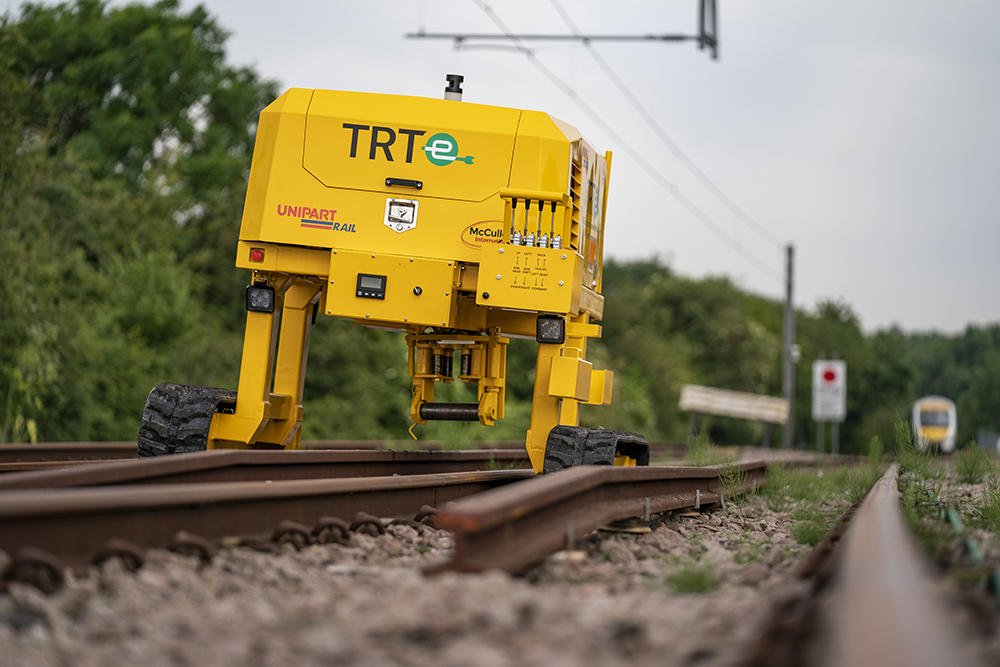
As we mentioned earlier, we have already taken steps to increase our presence in the rail sector over the last couple of years. Through our partnership with McCulloch Group and Unipart Rail, we have provided the electric motors for the industry-changing TRT-e – a zero-emissions Trac Rail Transposer. The vehicle is used to move sections of the railhead during track engineering works.
TRT-e has been in regular use with Network Rail, demonstrating considerable noise and emissions benefits when used over a similar diesel-powered equivalent.
Sector transformation doesn’t happen overnight. We’re excited about the opportunity that the railways possess, and our relationship with McCulloch Group, we feel, is a rewarding and positive start.