Why you shouldn’t underestimate England’s North East

We’re proud of our roots in here in the North East. Many people naturally assume that metropolises such as London, Birmingham and Manchester play host to the UK’s latest and greatest technological advances. But that’s not always the case. While its growth may have gone unnoticed by some, the North East is now rapidly gaining recognition as a hotbed of innovation.

Don’t just take our word for it. Earlier this year, Newcastle secured the fourth spot in the fDi Intelligence Top 10 mid-sized European cities of the future 2022/23 ranking. This was the outcome of their study to benchmark promising investment destinations across the continent. A report by the Department for International Trade has also revealed that the North East created more jobs than any region in the UK outside of London in 2021-22.   

For us, this result is hardly a surprise. The region has long been associated with pioneering ideas. From the first passenger carrying steam locomotive ‘Rocket’ and the earliest use of hydroelectric power, to the invention of the incandescent lightbulb and the steam turbine. But it seems that the North East’s close connection with mining and its well-publicised decline has fuelled an inaccurate, decades long stereotype that the area is in degeneration.    

It’s an exciting time to be part of the North East’s economy. It is becoming more and more apparent that the North East is the UK’s and the wider world’s hub for electrification. Nissan – a pioneer of the mass-produced EV with its Leaf – started the trend with its long-rooted presence in Sunderland. Now BritishVolt and Envision AESC are set to build the UK’s first two electric battery gigafactories in the region.  An increasing number of electrification technology SMEs are choosing the North East as their home, and we have the likes of the North East Automotive Alliance and the UK-wide DER-IC helping to promote and support sustainable supply chain growth. 

Advanced Electric Machines has a lot to thank the North East for. Our journey began with our Chief Executive Officer, Dr James Widmer, completing his PhD at Newcastle University. It was while working together with Dr Andy Steven from the university that James began to research and develop rare earth-free electric motors. In March 2017, Advanced Electric Machines was spun out as a stand-alone company and with the support of locally based experts, such as our Chief Operating Officer, Mike O’Neill, we’ve been able to grow and expand our presence in Tyne and Wear.

Our first production facility was opened in Blaydon, just a few miles outside the centre of Newcastle. We’re now based in Washington, a town roughly halfway between Newcastle and Sunderland. From here we employ a growing skilled and talented team, most of whom are based in and around the area.

There’s no question that the North East is on a positive trajectory, and we’re delighted to play our part.  

Origins of AEM – 2017

At Advanced Electric Machines, we’re now recognised across the globe for our rare-earth free high performance electric motors and powertrain systems. The journey to get to this point has not been simple, and we’re still only at the start of our overall mission to make the world’s EVs truly sustainable, but to get a picture of how everything began for us, let’s rewind to 2009.

At this point in time, our current Chief Executive Officer, Dr. James Widmer, was completing his PhD at Newcastle University after leaving BAE Systems to work on more sustainable technologies. This wasn’t an easy venture, however, with electric vehicles only just beginning to look like a feasible possibility. Also working at the university was Dr. Andy Steven, our current Chief Technical Officer. Andy, an expert in rotating machinery and transmission technologies, had a long and successful stint in industry, but, like James, he sought to pursue his passion for developing sustainable technologies in an increasingly unsustainable world.

James noticed that vehicle manufacturers were looking to employ permanent magnet motors as part of their electric vehicle solutions, and he realised that if these vehicles were to become the norm, the quantity of rare earth metals needed could become catastrophic for the environment.

From here, James began to research and develop rare earth-free electric motors, supporting the first-generation development of OEM vehicles with JLR, Airbus and Cummins in the process. He then became the Director of the Advanced Propulsion Centre’s Electric Machines Spoke, a role in which he would meet future Advanced Electric Machines Chief Commercial Officer, Mike Woodcock. Mike acknowledged another limitation of the use of permanent magnet electric motors – the lack of a route to recycling due to the copper and magnets they contain, meaning many would end up in landfill. This led the pair to question the possibility of removing the rare earths and the copper from the motor, and creating a fully recyclable solution. This would become the eventual mission statement of Advanced Electric Machines.

James and Andy’s work eventually led the pair to a realisation that they had developed a commercially viable product that had the chance to change the world.

Fast forward to March 2017 – a poignant moment in time for everybody involved in Advanced Electric Machines. It saw us spin out of Newcastle University and into the wider world, with James and Andy leading the charge. James and Mike Woodcock would then meet Mike O’Neill, who would become our Chief Operating Officer. Mike had been establishing high volume motor manufacturing lines across the world at ZF, and this skillset perfectly fit the bill for us to achieve our mission. Mike decided to join the team to reignite the North East’s roots in industrial engineering excellence and to build a company from the ground up.

It wasn’t long before the idea of this revolutionary company became a reality. Just a month later in April, we hit two prominent landmarks on our journey to becoming a globally recognised business. We secured our first Innovate UK grant, with this funding a recognition of the innovation that we were bringing to the table. The support of this grant enabled us to develop the business authentically, investing in the infrastructure that is in place today.

Speaking of infrastructure, in April we also signed the lease on our first production facility at Blaydon. For any business, acquiring a bespoke facility is a huge milestone, and for us, it physically established us in the North East, which we regard as the country’s hub for industrial engineering. At Blaydon, it took mere months for us to turn the location from an empty shell to a facility where our first motor was built and tested.

We didn’t stop there, either. By early July, we had completed a round of seed funding in order to assemble the funds to shape the business that we strove to create. And to round off what was an extremely busy first few months, we hit another significant milestone in securing our first commercial contract.

The beginning phase of any business is bound to be busy, and the same can be said for the origins of AEM. Nevertheless, this chapter in our history set us on the path that we are still on today, and we have no intention of slowing down.

Our People

We are extremely fortunate at Advanced Electric Machines to have an incredibly talented and hardworking group of people on board. The people in our team are exceptional, and bringing them in has been a key aim of our recruitment strategy since the company’s inception. It is our goal to create a workplace where our people can apply their talent, creativity and passion to help us produce the most sustainable electric motors in the world.

Over the last few years, we have been working hard behind the scenes to adopt a strategic recruitment policy that has centred around bringing in the right people. In September 2020, we took on our first apprentice, George Cram, who was delighted to be given the opportunity to study at Sunderland College and work alongside top class engineers. The engineering department has steadily grown, with university graduates coming from across the country to play their role in our history. Caspar Tatham is one such graduate, who joined the business as a Graduate Mechanical Design Engineer and cited our drive towards sustainability as the decisive factor in his decision to come on board.

With the company only having burst into existence just over five years ago, our team is still growing. In 2020, the size of our team grew dramatically, doubling from 16 to 32 people, while now we’re at more than 50. Every single member of the Advanced Electric Machines team is carefully picked, with no stone going unturned in the pursuit of a harmonious and resourceful workforce.

One of our key appointments over the years was Claire Burgess, who joined the team as the Chief Financial Officer in January 2021. Claire’s role is to drive the growth of the business, focusing on financial investment to propel our rare earth free electric motors into the global market. As with many of our new starters, Claire pointed out the “game-changing” nature of our “fully green and recyclable” offering as a huge pull to the company. For us, it is essential to have a team that are truly passionate about making the right changes in our industry.

Alongside Claire, we have brought in a number of other senior members of staff recently. For example, Mark Johnson was appointed to the role of Power Electronics Director. Mark is an internationally recognised expert in the field of power electronics and he is on-hand to support us in the provision of the most sustainable electric motors worldwide. Also new to the team is Lee Woodcraft – Special Projects and Aftersales Director – who will be an integral part of our efforts to drive the forward planning of the business on an international level. Steve Simmonds has also become an integral part of our engineering team since joining us last year as Product Development Director, Steve is responsible for leading all of our customer and partner projects.

Our progress as a business is also reflected in the growth of our exceptional production team. The team is led by Richy Bruce, and has grown from consisting of three members to a strong unit people over the last 12 months. This progress has seen the team go from building single prototypes a week to now building increasing volumes every single week to meet the ever-growing demand from our customers.

We are delighted with the team that we have in place. Every single member of staff has a crucial role to play in our journey, and we’re passionate about bringing in the right people to continue to take us forward.

How do we make electric vehicles genuinely sustainable?

There is no doubt that electrification is key to addressing climate change. Yet it is not as simple as merely implementing conventional infrastructure; the technologies that are developed must be more sustainable to manufacture, use and recycle than those they replace.

At Advanced Electric Machines we have made it our mission to design and build the most sustainable electric motors on the planet, and supply them around the globe from our facilities in the UK. But how do we aim to do this? Here, we will run through the situation we’re faced with, and we will demonstrate what drives us to achieve our goals, as well as laying out how we plan to make this a reality.

The messy business of rare-earth metals

If you’ve followed our work over the past couple of years, especially during last year’s COP26 summit, you’ll know that we’re not afraid to draw attention to the volatile world of rare-earth metals. In fact, we’ve been banging the drum of discontent ever since we started Advanced Electric Machines in 2017.

As a bit of background, most electric vehicles on our roads today use permanent magnet motors. This is because it’s a proven technology and was, until now, thought to be the most efficient means of powering a vehicle. The issue we have with permanent magnet motor technology is that each unit uses some 2kg of rare-earth magnets.

Ultimately, however, things need to change – there are grave costs to using rare earth metals. The mining of rare earth metals is, in short, damaging to the environment and harmful to those involved. For every single tonne of rare earth metals mined, it’s been reported that up to 1.4 tonnes of radioactive waste can also be produced. Mining 12 tonnes can generate enough acid-containing sewage water to fill an Olympic-sized swimming pool. If you compare rare earth mining to steel production, mining rare earths creates over 11 times more CO2 than every tonne of steel manufactured.

It’s not just the social and environmental issues of rare earth mining that need to be considered. As their name suggests, rare earth metals are only available in low quantities globally due to the highly complex process involved in their extraction. And scarcity, unsurprisingly, translates into a premium price point and a volatile trading market. From February 2020 to February 2022, the cost of neodymium has risen by 312%, with one kilogram now costing more than $236, compared to $42 just two years ago. How can vehicle manufacturers scale their models with fluctuations as dramatic as that?

Removing rare earths

The only way to eliminate this problem is to eliminate the rare earths in motors entirely.

It’s hard, however, to criticise the practice when it seems that no viable alternative is available. That’s why we’ve spent several years developing our own semi-sinusoidal motor technology that does away with the rare earth magnets that limit an electric motor’s scope.

By removing the magnet in our design, Advanced Electric Machines motors can spin twice as quickly as a permanent magnet motor. This makes it up to 12% more efficient and kinder to the environment. We can also exchange the copper windings for a compressed aluminium design. It means that our motor is made almost entirely out of steel and aluminium – both of which are easy to recycle through existing channels.

Thankfully, we’re starting to see the awareness around rare-earth mining grow. We’ve seen it not only amongst the major automotive manufacturers and their engineers, but with the rising number of environmentally conscious product buyers, too. We all have an appetite to go green, but it will be all in vain if we don’t remember our duty to do so sustainably.

Copper – where things stand

This desire to become increasingly sustainable is an excellent and highly necessary initiative, but it hasn’t come without difficulty.

One of the greatest challenges we are beginning to understand the true scale of is the growth in demand for raw materials; from neodymium to cobalt to copper. Copper is central to the new technologies being created to meet the world’s environmental goals, with The Institute for Human Rights and Business predicting there will be a 300% rise in demand for copper by 2050. This equates to 60 million tonnes of the metal being required every year, but at what cost?

The costs of copper

As demand increases, so does the environmental, human, and financial cost. Up until now, the demand for copper has remained at a manageable level. The capacity to recycle the copper in circulation to meet demand has been hugely beneficial, as it has reduced the need to mine for it. Copper mining has a known detrimental impact on people’s health and the natural environment, leading to land degradation, deforestation, and water and air pollution. Unfortunately, with demand on the rise, recycling the existing copper will no longer be sufficient, leaving no option but to greatly increase the levels of mining.

We must also consider the financial cost of copper. In March 2022, prices spiked for the third time in less than a year, as copper stocks approached historically low levels of just 200,402 tonnes – that does not even cover three days of global consumption at the current rate. As the world risks ‘running out of copper’, CNBC reports that prices could rise to $20,000 per tonne in the next five to ten years, which, when combined with the expected rise in demand, begins to paint a very costly picture.

Copper and the electrification revolution

Since Michael Faraday discovered electromagnetic induction using copper coils over 200 years ago, copper has been the metal of choice for an electrical conductor. It is, therefore, no surprise that copper is at the very core of the electric revolution. Electric vehicles are key in the global drive towards net-zero, but their batteries, motors, electrical components and even charging equipment all use copper to function.

In electric vehicles, traction motors contain copper coils that an electric current passes through to generate mechanical energy that will spin the motor and propel the vehicle. This contributes to the average battery-electric car containing 83kg of copper, which is four times that used in petrol and diesel cars.

With governments across the world setting deadlines to ban the sale of petrol, diesel, and even hybrid vehicles, battery-electric vehicles will begin to monopolise the market. According to the Financial Times, if electric vehicle sales hit the expected 40% increase by 2030, around eight times more copper will be required for annual vehicle production.

The argument goes that copper is one of the most highly recycled metals, with around two thirds of all copper mined still being used today. However, demand has never been this high, and the copper in electric motors is extremely difficult and expensive to extract for recycling, which means the motors, and the copper in them, often just ends up in landfill. As EV production ramps up, so does the amount of copper being demanded but not recycled. Unless an alternative is found, more copper will have to be mined, but is this really a sustainable future?

A different future

We see a different future. As experts in designing and manufacturing the most sustainable electric motors, we have developed an alternative technology that will allow us to remove copper from our next generation motors. Advanced Electric Machines has designed highly compressed aluminium windings to replace traditional copper coils that maintain the performance characteristics of the electric motors, but in a more efficient and sustainable way.

It is undeniable that copper will have a huge role to play in the future of the electric revolution, and required supply will need to greatly increase to meet the demand. Nevertheless, at Advanced Electric Machines we are always striving for the most sustainable solutions.

Our motor technology explained

As has been established, electric vehicles are not without their drawbacks. By now, you will be well aware that recycling issues and the modernisation of rare earth mining practices are big obstacles that need to be overcome in order to ensure a sustainable transition to implementing electrified transport. To compound this, any alternative solutions put forward are challenged with the need to be at least as powerful, torque dense and efficient as existing technologies.

The electric motor is a critical element of the EV powertrain, and must not be overlooked in the search for greater sustainability. For years now, the conventional permanent magnet machine has been the motor of choice for automotive manufacturers, and has been regarded as the most effective solution for electric vehicles. We have already established the environmental issues that this technology brings to the fore, and this has not been lost on vehicle manufacturers, who are now actively seeking rare-earth free alternatives.

The problem with this type of motor is not just environmental, but its relative cost and complexity. However, as some manufacturers move to rare-earth free options, they are finding themselves compromising efficiency and performance, and in some cases, their solutions are even less sustainable due to their increase in size and the increased amounts of alternative materials they use.

Step forward Advanced Electric Machines. Our solution takes away these concerns, removing the problematic rare earth magnets from the motor design and simultaneously improving efficiency, increasing performance and lowering cost.

How? Well, we’ve replaced the rotor magnet with electrical steel, and can swap the copper coils in the stator with highly compressed aluminium windings. As we’ve established, this has a hugely positive environmental impact, as our choice of materials means our motor is fully recyclable at end-of-life, leading to less e-waste.

The benefits of removing magnets from the motor also mean that operating risks are reduced, with no chance of short circuit currents or the high voltage spikes which can be experienced with permanent magnet motors. We can therefore ensure safer failure modes should something go wrong. In addition, our magnet-free motors have no risk of demagnetisation, as temperatures increase at higher rotational speeds, which allows for our motors to run much faster, whilst also enabling a simpler thermal management system for the vehicle.

The benefits

In terms of cost, it is expensive to use rare earth magnets in motors, with each motor containing at least $200 worth of magnets alone. The volatile supply of neodymium – the main rare earth metal used in electric motors – also means there is significant scope for the price to increase much further. Put simply, vehicle manufacturers will find it difficult to plan the scale-up of electric vehicles in the numbers required when the cost of a key component can be so volatile.

And then there’s package efficiency. The faster a motor spins, the more power dense it can be. Typically, this faster spin will lead to problems with rare earths, but our motor is, of course, a little bit different. Without magnets, we can make the motor spin twice as fast, making it easier to package and lighter in weight. The fact that our motors are inert when not being driven enables the vehicle to coast. This has led to an increase in efficiency of up to 12% being reported by our customers over conventional permanent magnet motors throughout a typical vehicle drive cycle.

As you can see, our solution solves many of the problems that are found in producing electric motors. In order for electric vehicles to be as sustainable as possible, change needs to be embraced, and if it is, then a truly green future can be a reality right now.

Working with TEVVA and the Advanced Propulsion Centre

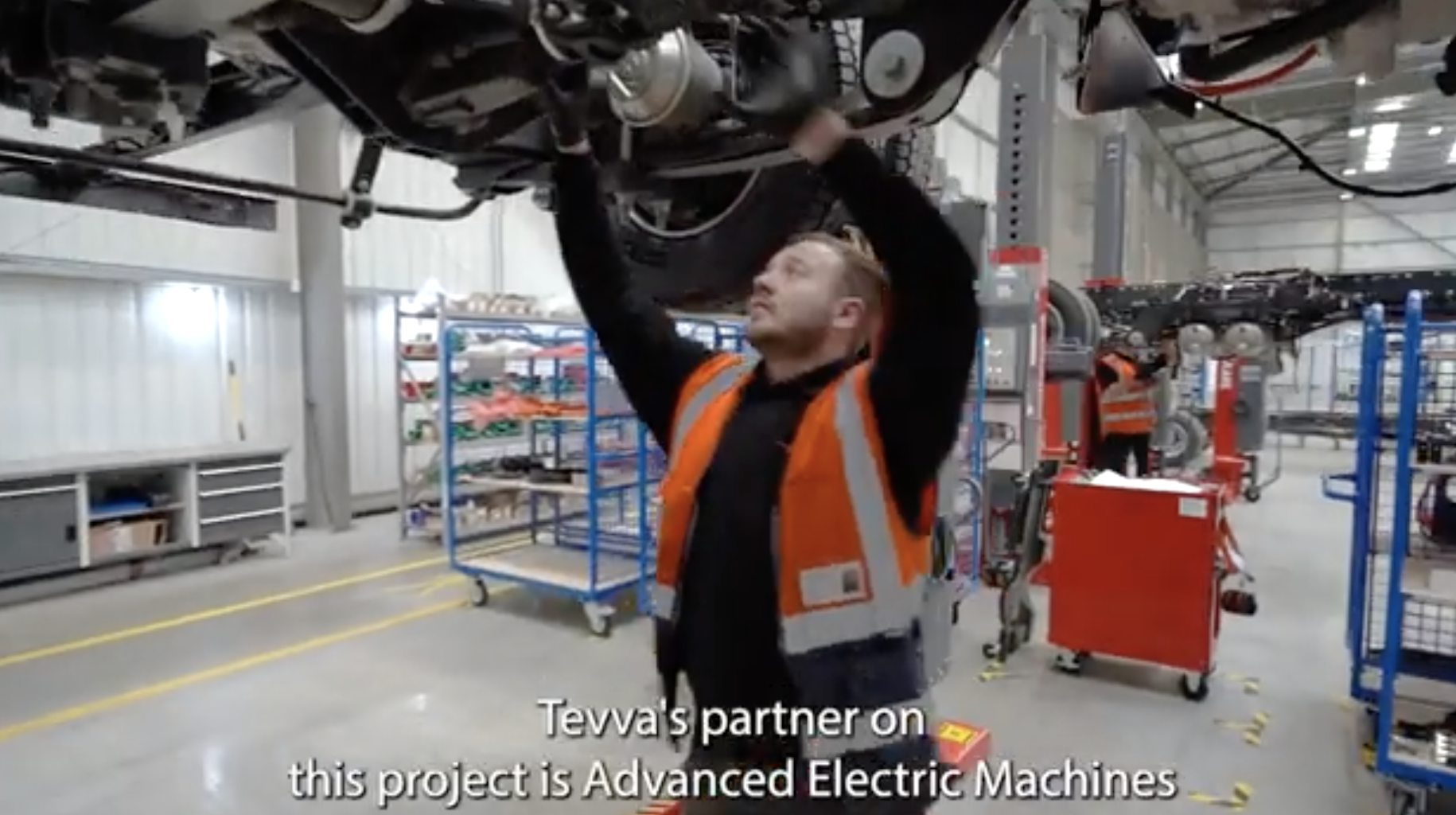
For several years, we’ve been working closely with TEVVA on the development of its hydrogen fuel cell range-extended truck. Part-funded by the Advanced Propulsion Centre (APC), the project, known as SANGREAL has seen us work together to develop a truly game-changing solution for the electrification of the road haulage sector. 

Later this year, Tevva will deliver production vehicles to its first customers, with each vehicle featuring an Advanced Electric Machines rare-earth free high performance HDSRM 300 motor.

Recently, the APC caught up with Tevva on the project, which you can view below.

Our bespoke motoring solutions

Five years ago, we set out on our journey to build the world’s most sustainable electric motors. Along the way, we have always sought to develop long-term partnerships with like-minded companies that have wanted our technology to create a bespoke motor offering that fits their requirements. On this path, we have come across businesses in sectors from commercial vehicle to rail to renewables that have been drawn to us because of their desire for a high performing and truly sustainable product.

At AEM, we have a wide-ranging product portfolio that caters to the needs of those in search of an electric motor. Our HDSRM™ product family in particular offers a scalable and modular design to meet a variety of applications, including passenger cars and commercial vehicles, as well as in the maritime and railway industries.

Nevertheless, from time to time, we receive enquiries that specify a change in direction. Typically, the process of partnering with a business to provide them with the right product begins with our team investigating whether any of our products are tailored to their product specification. If there isn’t a match, we will look into how we can develop a product for them. This involves us identifying whether modifications can be made to one of our current motors to fit what is required, or whether we will need to build something entirely new.

In terms of making modifications, we take everything into account, from the length and weight of the motor to the amount of torque the customer requires. Within our product portfolio, there is plenty of room to manoeuvre, enabling us to cater to the needs of our customers to create the right product for them.

If this is not an option, and we see a bigger opportunity at play, we will go the extra mile and develop a bespoke motor with our customers. This process is a collaborative approach; although the designing and manufacturing are done by us, we remain in constant communication with our customers to ensure we are creating a product that fits all their requirements. In our partnership with the commercial vehicle manufacturer, SAF-Holland, for example, we have been holding weekly progress meetings and maintaining an ongoing action list for over a year now. Over this period, we have designed and manufactured a bespoke motor that integrates into SAF Holland’s innovative e-axle system, the TRAKr.

For these bespoke projects, we typically anticipate that the motor will be ready in 12 months, but we will always adapt to the situation at hand. As the manufacturer of the world’s most sustainable and high-performance electric motors, we welcome interest from other companies in establishing long-term relationships that can facilitate the development of the sectors we operate in. Whether our active product range is suitable for a prospective client’s needs or not, we are always open to collaborating and finding the right solution.

Copper – where things stand

No secret has been made of the global ambition to reach net-zero emissions and greater sustainability. On the surface, this is an excellent and highly necessary initiative, but it hasn’t come without its challenges.

One of the greatest challenges we are beginning to understand the true scale of, is the growth in demand for raw materials; from neodymium to cobalt to copper. Copper is central to the new technologies being created to meet the world’s environmental goals, with The Institute for Human Rights and Business predicting there will be a 300% rise in demand for copper by 2050. This equates to 60 million tonnes of the metal being required every year, but at what cost?

THE COSTS OF COPPER

As demand increases, so does the environmental, human and financial cost

Up until now, the demand for copper has remained at a manageable level. The capacity to recycle the copper in circulation to meet demand has been hugely beneficial, as it has reduced the need to mine for it. Copper mining has a known detrimental impact on people’s health and the natural environment, leading to land degradation, deforestation, and water and air pollution. Unfortunately, with demand on the rise, recycling the existing copper will no longer be sufficient, leaving no option but to greatly increase the levels of mining.

We must also consider the financial cost of copper. In March 2022, prices spiked for the third time in less than a year, as copper stocks approached historically low levels of just 200,402 tonnes – that does not even cover three days of global consumption at the current rate. As the world risks ‘running out of copper’, CNBC reports that prices could rise to $20,000 per tonne in the next five to ten years, which when combined with the expected rise in demand begins to paint a very costly picture.

COPPER AND THE ELECTRIFICATION REVOLUTION

This is a scaling problem driven by the rise of electric vehicles

Since Michael Faraday discovered electromagnetic induction using copper coils over 200 years ago, copper has been the metal of choice for an electrical conductor. It is, therefore, no surprise that copper is at the very core of the electric revolution. Electric vehicles are key in the global drive towards net-zero, but their batteries, motors, electrical components and even charging equipment all use copper to function.

In electric vehicles, traction motors contain copper coils that an electric current passes through to generate mechanical energy that will spin the motor and propel the vehicle. This contributes to the average battery-electric car containing 83kg of copper, which is four times that used in petrol and diesel cars.

With governments across the world setting deadlines to ban the sale of petrol, diesel, and even hybrid vehicles, battery-electric vehicles will begin to monopolise the market. According to the Financial Times, if electric vehicle sales hit the expected 40% increase by 2030, around eight times more copper will be required for annual vehicle production.

Is this a problem?

The argument goes that copper is one of the most highly recycled metals, with around two thirds of all copper mined still being used today. However, demand has never been this high, and the copper in electric motors is extremely difficult and expensive to extract for recycling, which means the motors, and the copper in them, often just ends up in landfill. As EV production ramps up, so does the amount of copper being demanded but not recycled. Unless an alternative is found, more copper will have to be mined, but is this really a sustainable future?

A DIFFERENT FUTURE

How we can support the sustainable growth of electric vehicles

We see a different future. As experts in designing and manufacturing the most sustainable electric motors, we have developed an alternative technology that will allow us to remove copper from our next generation motors. AEM has designed highly compressed aluminium windings to replace traditional copper coils that maintain the performance characteristics of the electric motors, but in a more efficient and sustainable way.

It is undeniable that copper will have a huge role to play in the future of the electric revolution, and required supply will need to greatly increase to meet the demand. However, it is important to us at AEM that we are always striving for the most sustainable solutions, why else are we all investing so much in electric vehicles if not to ensure a greener future?

Electric vehicles – the growing picture

It’s difficult to ignore the increasing number of electric vehicles (EV) arriving onto our streets. In the UK, electric vehicle licence plates boast a strip of green as a sign to others that it generates zero tailpipe emissions. From fuel stations to supermarket car parks, spaces are being handed over to electric vehicle charging points.

The electric vehicle revolution has begun. The question is, at what rate is it expected to grow and at what point will we live in a majority EV world?

SCALING UP

The demand is only set to grow

According to data from the SMMT, the industry body that monitors registrations in the UK, battery electric vehicle sales grew by more than 26% last year and, in doing so, secured around a quarter of the market share. Naturally, it would be a bold and somewhat unrealistic prediction to say that, by continuing to grow at this rate, all cars sold in the UK will be battery-electric by 2025. But plans put in place by the UK Government will see the sale of new non-hybrid internal combustion vehicles banned by 2030.

Looking at the global picture, the expected growth of electric vehicles over the next decade is more modest but by no means insignificant. Research by BloombergNEF suggests that, by 2025, worldwide EV sales are expected to reach 14 million per year, with a global fleet totalling 54 million vehicles.

SUSTAINABILITY IS CRITICAL

Higher demand leads to a higher environmental burden if technology doesn’t change

There’s still a considerable amount of uncertainty beyond this point. Factors including the price of components, infrastructure viability and governmental incentives will undoubtedly impact the speed of adoption. If the predictions are correct and we’re on track to reach annual sales of 14 million EVs globally by 2025, in the shorter term we all need to play a part in delivering sustainable electrification collectively. If not, we risk causing more environmental damage.

Our semi-sinusoidal motor technology is part of the solution. By removing the rare-earth magnets from our motors, we’re also able to mitigate the need for finite materials sourced by dirty mining practices and traded in volatile markets.

Clearly, we’re still several years away from understanding the true EV endgame. In a decade or so, it will be interesting to reflect on how the industry’s predictions were reflected in reality. Regardless, we hope that others will join us in ensuring that the journey is made with true sustainability at its core.

Our motor technology explained

As has been established, electric vehicles (EVs) are not without their drawbacks. Recycling issues and the modernisation of rare earth mining practices are big obstacles that need to be overcome in order to ensure a sustainable transition to implementing electrified transport. To compound this, any alternative solutions put forward are challenged with the need to be at least as powerful, torque dense and efficient as existing technologies.

The electric motor is a critical element of the EV powertrain, and must not be overlooked in the search for greater sustainability. For years now, the conventional permanent magnet machine has been the motor of choice for automotive manufacturers, and has been regarded as the most effective solution for electric vehicles. We have already established the environmental issues that this technology brings to the fore, and this has not been lost on vehicle manufacturers, who are now actively seeking rare-earth free alternatives.

The problem with this type of motor is not just environmental, but its relative cost and complexity. However, as some manufacturers move to rare-earth free options, they are finding themselves compromising efficiency and performance, and in some cases, their solutions are even less sustainable due to their increase in size and the increased amounts of alternative materials they use.

Step forward AEM. Our solution takes away these concerns, removing rare earth magnets from the motor design and simultaneously improving efficiency, increasing performance and lowering cost.

How? Well, we’ve replaced the rotor magnet with electrical steel, and the copper coils in the stator with highly compressed aluminium windings. As we’ve established, this has a hugely positive environmental impact, as our choice of materials means our motor is fully recyclable at end-of-life, leading to less e-waste.

The benefits of removing magnets from the motor also mean that operating risks are reduced, with no chance of short circuit currents or the high voltage spikes which can be experienced with permanent magnet motors. We can therefore ensure safer failure modes should something go wrong. In addition, our magnet-free motors have no risk of demagnetisation, as temperatures increase at higher rotational speeds, which allows for our motors to run much faster, whilst also enabling a simpler thermal management system for the vehicle.

In terms of cost, it is expensive to use rare earth magnets in motors, with each motor containing at least $200 worth of magnets alone. The volatile supply of neodymium – the main rare earth metal used in electric motors – also means there is significant scope for the price to increase much further. From February 2020 to February 2022, the cost of neodymium has risen by 312%, with one kilogram now costing more than $236, compared to $42 just two years ago. Put simply, vehicle manufacturers will find it difficult to plan the scale-up of electric vehicles in the numbers required when the cost of a key component can be so volatile.

And then there’s package efficiency. The faster a motor spins, the more power dense it can be. Typically, this faster spin will lead to problems with rare earths, but our motor is, of course, a little bit different. Without magnets, we can make the motor spin twice as fast, making it easier to package and lighter in weight. The fact that our motors are inert when not being driven enables the vehicle to coast. This has led to an increase in efficiency of up to 12% being reported by our customers over conventional permanent magnet motors throughout a typical vehicle drive cycle.

As you can see, our solution solves many of the problems that are found in producing electric motors. In order for electric vehicles to be as sustainable as possible, change needs to embraced, and if it is, then a truly green future can be a reality right now.

Find out more about our products.

SCG International joins Cho Thavee and Asia Cab in Signing Thai MOU with AEM

SCG International Corporation has signed a landmark Memorandum of Understanding (MOU) with Advanced Electric Machines Ltd (AEM), Cho Thavee Public Company Limited (CTV), and ASIA CAB Co to develop innovative solutions that will enable internal combustion engined cars to be electrified using AEM’s sustainable motors.

Advanced Electric Machines Ltd (AEM) is a leading manufacturer of sustainable electric motors based in the United Kingdom. The company designs and manufactures rare-earth magnet-free EV motors for the automotive and transportation sectors, leveraging its materials, manufacturing, and design expertise to deliver the most efficient and cost-effective solutions. AEM’s sustainable motor has registered several international patents on its proprietary technology since 2016.

James Widmer, CEO of Advanced Electric Machines Ltd (AEM), said: “The MOU represents a significant strengthening of our position in the Asian market. We are delighted to have SCG International as a partner, as it allows us to play a role in building a sustainable electrification future for Thailand and Southeast Asia. The latest order from Asia Cab is testament to this, and we look forward to working with them to develop our future electrified range.”

In line with its vision ‘To Be The Most Trusted International Business Partner’, SCG International aims to leverage its international business expertise in this collaboration and promote clean mobility, complying with ESG (Environmental, Social, Governance) principles.

“The collaboration of three Thai parties (CTV, Asia Cab, and SCG Intl) with AEM will not only bring superior technology to the automotive market, but in line with SCG Group’s policy, it will also accelerate the adoption of Clean Mobility,” said Abhijit Datta, Managing Director of SCG International Corporation Co., Ltd. “SCG International values sustainability and hopes that our EV solution platform will contribute to Thailand’s sustainability goals. We will provide our customers a one-stop service with smart, affordable, and worry-free solutions spanning the vehicle’s life cycle.”